Orforglipron vs Oral Semaglutide: What Actually Differs?
Direct answer
Orforglipron is a non-peptide oral GLP-1 agonist, while oral semaglutide uses a peptide formulation with an absorption enhancer. Orforglipron lowered HbA1c more in ACHIEVE-3, but that trial did not test Wegovy's 25 mg tablet. Compare the indication, formulation, eating restrictions and tolerability before comparing a supply quote.
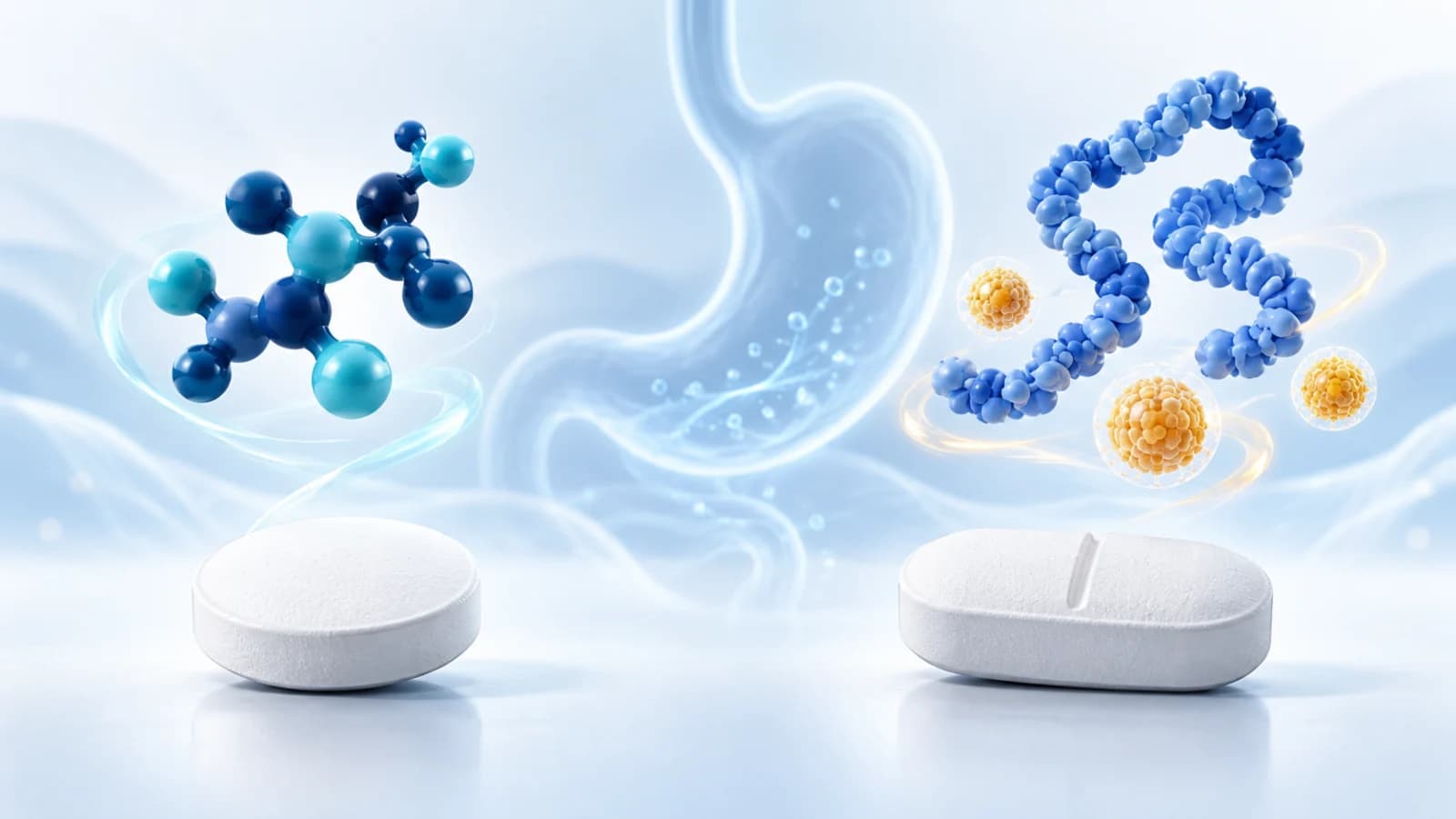
Concept illustration of oral delivery; not exact molecular structures or supplied products.
On this page
- 01Before comparing the tablets, name the comparator
- 02The important difference happens before the drug reaches its target
- 03ACHIEVE-3: where orforglipron has a direct comparison
- 04Why the obesity comparison is not settled by that trial
- 05Tolerability and longer-term outcomes change the conversation
- 06Why the milligrams in a paper can mislead a tablet buyer
- 07Put both quotations on the same commercial basis
- 08Make the next conversation more specific
1. Before comparing the tablets, name the comparator
Someone sends you a headline: orforglipron beats oral semaglutide. Someone else sends a weight-loss chart with semaglutide ahead. Both point to published research. Neither has necessarily misquoted a number. They may simply be answering different questions.
That is the problem with comparing these products by molecule name alone. "Oral semaglutide" can mean a diabetes treatment, a different tablet formulation, or an obesity treatment. A result against one does not settle the comparison against all of them.
For a clinic, the first question is the treatment objective. For a distributor, it is which finished product the customer is actually requesting. For a buyer collecting quotations, it is whether two suppliers have even quoted the same thing. Those questions come before a price comparison, not after the order arrives.
Three names worth separating
Swipe to view all columns
| Name used in the discussion | What it identifies | What not to assume |
|---|---|---|
| Orforglipron | A non-peptide GLP-1 receptor agonist; Foundayo is Lilly's named US product | That every tablet carrying the molecule name is Foundayo |
| Oral semaglutide 7 mg or 14 mg in ACHIEVE-3 | The semaglutide comparator formulations in the diabetes trial | That this was a comparison against the obesity tablet |
| Wegovy tablets | A named semaglutide product with a 25 mg maintenance strength | That results from the 14 mg comparator describe its performance |
Foundayo received US FDA approval on April 1, 2026, for eligible adults with obesity or overweight and a weight-related condition. That approval is product-specific and jurisdiction-specific. The current US prescribing information for Foundayo, Rybelsus/Ozempic tablets and Wegovy is linked below; readers outside the US should check the relevant local authorisation rather than treating a US label as worldwide permission.
This article separates three decisions: what the clinical evidence establishes, what taking the named medicines involves, and what belongs in a commercial tablet quotation. It is not a switching or dose-conversion guide.
The comparison in one sentence: A stronger result against a diabetes-dose comparator does not establish a stronger result against every oral semaglutide product. Name the formulation and the question before declaring a winner.
2. The important difference happens before the drug reaches its target
Both medicines act at the GLP-1 receptor. Their route to that receptor is different.
Semaglutide is a peptide. Its established oral formulations use the absorption enhancer salcaprozate sodium, usually called SNAC; absorption occurs predominantly in the stomach. The formulation helps make oral delivery possible. Orforglipron is a non-peptide small molecule, so it does not use semaglutide's peptide-plus-SNAC delivery approach. These distinctions are described in the official product information linked below.
For someone choosing a daily routine, the practical consequence is more useful than the chemical terminology. The current US Foundayo label does not impose food or water restrictions. The oral semaglutide labels require an empty stomach in the morning, plain water up to four ounces, and a wait of at least 30 minutes before food, other drinks or other oral medicines. These are instructions for those named products, not a generic rule for any independently supplied tablet.
Convenience is a real difference, not a complete outcome
Consider a shift worker whose breakfast time changes, or someone who already has a tightly scheduled morning medication routine. The relevant question is not whether swallowing a tablet is easier than an injection. Both options here are tablets. It is whether the conditions attached to that tablet fit the person's day.
That makes orforglipron's less restrictive administration a meaningful feature. It does not, by itself, prove better long-term adherence or greater weight loss. Those are separate outcomes. An easier instruction can remove one obstacle without removing every reason someone might stop treatment.
Early orforglipron food-effect studies measured changes in drug exposure after meals, but the investigators judged the magnitude unlikely to be clinically meaningful. "No food restriction" therefore should not be rewritten as "food produces absolutely no pharmacokinetic change."[1]
- For clinicians: Discuss the actual daily routine, including other medicines, rather than assuming all oral GLP-1 products behave alike.
- For distributors: Keep the named product and its instructions together. A convenient claim detached from its formulation is incomplete.
- For tablet buyers: Ask what evidence supports the supplied formulation. The active ingredient's identity alone does not establish its absorption performance.
3. ACHIEVE-3: where orforglipron has a direct comparison
ACHIEVE-3 randomised 1,698 adults with type 2 diabetes inadequately controlled on metformin. It compared two orforglipron regimens with two oral semaglutide regimens over 52 weeks. It was open-label, not blinded, and funded by Lilly.[2]
The primary blood-glucose result favoured orforglipron. The table uses the paper's treatment-regimen analysis, which evaluates the assigned treatment strategy rather than only participants who remained on treatment. HbA1c changes are percentage points, not percentage body-weight loss.
Swipe to view all columns
| Study regimen | HbA1c change at week 52 | Gastrointestinal adverse events | Stopped treatment because of adverse events |
|---|---|---|---|
| Orforglipron 12 mg | −1.71 percentage points | 59% | 9% |
| Orforglipron 36 mg | −1.91 percentage points | 58% | 10% |
| Oral semaglutide 7 mg | −1.23 percentage points | 37% | 4% |
| Oral semaglutide 14 mg | −1.47 percentage points | 45% | 5% |
Source: ACHIEVE-3 publication; adverse-event percentages are rounded as reported in its abstract. These are study regimens, not prescribing instructions.[2]
Read across the row, not down one column
There is a straightforward commercial temptation here: lift the efficacy column into a sales slide and leave the rest behind. That produces a simpler message, but a weaker discussion with an informed buyer. The same comparison contains tolerability information. A clinic director will eventually ask about both.
The right way to present a trial is to keep its trade-offs in view. A result can be persuasive without being universal. If the customer is asking about glycaemic control in a similar population, this is directly relevant evidence. If the question concerns weight management without diabetes, a different evidence set belongs on the desk.
Another useful habit is to keep the analysis label beside a headline. Research reports may present both treatment-regimen and efficacy estimates. The latter addresses a different question about treatment exposure and intervening events. Mixing numbers from the two can make an apparent advantage larger or smaller without changing the underlying participants.
For your own comparison notes, retain four fields with every result: population, comparator, time point and analysis. A percentage copied without those fields is difficult to use responsibly, however impressive it looks.
4. Why the obesity comparison is not settled by that trial
For obesity without diabetes, two placebo-controlled studies are central: ATTAIN-1 for orforglipron and OASIS 4 for oral semaglutide. They were not two arms of the same experiment.[3][4]
Swipe to view all columns
| Separate study | Population and size | Regimen shown | Weight endpoint | Mean weight change: active vs placebo |
|---|---|---|---|---|
| ATTAIN-1 | 3,127 adults with obesity, without diabetes | Orforglipron 36 mg study formulation | Week 72 | −11.2% vs −2.1% |
| OASIS 4 | 307 adults with overweight or obesity, without diabetes | Oral semaglutide 25 mg | Week 64 | −13.6% vs −2.2% |
The figures above use treatment-regimen estimates. ATTAIN-1 was funded by Lilly; OASIS 4 by Novo Nordisk. The OASIS 4 trial lasted 71 weeks, but the primary weight endpoint was at week 64.[3][4]
It is reasonable to put those results side by side for orientation. It is not reasonable to treat their subtraction as a randomised head-to-head result. Follow-up times, participant characteristics and trial conduct can influence the comparison. A shared placebo label does not make the study populations interchangeable.
There is also an indirect comparison
A 2026 population-adjusted analysis used participant-level OASIS 4 data and aggregate ATTAIN-1 data. It adjusted for selected baseline differences and favoured oral semaglutide 25 mg for weight reduction: the treatment-regimen estimate differed by 3.2 percentage points, with a 95% confidence interval of 0.4 to 5.9 points in semaglutide's favour. The study was supported by Novo Nordisk.[5]
That finding belongs in an honest comparison. It is more informative than subtracting two headline percentages yourself, but it remains an indirect analysis with assumptions about comparability. It does not become a direct trial because the statistical adjustment is sophisticated.
Different evidence, different conclusion: Keep a head-to-head diabetes trial, separate obesity trials and an adjusted indirect obesity comparison in separate categories. None should silently stand in for another.
The useful conclusion is narrower than either brand's most enthusiastic headline: there is a direct diabetes comparison and an evolving obesity comparison. Buyers should be able to discuss that distinction without dismissing either molecule.
5. Tolerability and longer-term outcomes change the conversation
"Which works better?" sounds like one question. In a clinic it usually becomes several. Better for glucose control? Weight reduction? A workable daily routine? Staying on treatment? A particular long-term health outcome?
The answers need not all point in the same direction. That is why the preceding efficacy table also includes treatment discontinuation. A measured effect and the ability to continue treatment belong in the same discussion, even though they are not the same outcome.
Make the follow-up specific
Useful patient feedback describes what happened, when it happened and which exact product was taken. "Oral GLP-1s did not suit me" leaves too much unresolved. A clinician needs the product, prescribed regimen, symptom timing and other medicines to assess the problem. A supplier needs batch and packaging details if a product-quality concern is suspected. Those are different investigations, and neither should be reduced to an argument about which brand won a trial.
- Routine problems: Separate difficulty following administration instructions from a suspected adverse reaction.
- Treatment changes: Keep decisions about starting, escalation and switching with the prescribing clinician; comparative trial doses are not a conversion chart.
- Quality complaints: Record the product and batch. An efficacy paper cannot explain a broken blister or a mismatched label.
Weight is not the only endpoint with evidence
In SOUL, 9,650 people with type 2 diabetes and established cardiovascular disease, chronic kidney disease, or both were randomised to oral semaglutide or placebo alongside standard care. Major cardiovascular events occurred in 12.0% versus 13.8%; the hazard ratio was 0.86 over a median follow-up of 49.5 months. That is evidence for a defined high-risk population, not a promise of the same effect for every person seeking weight loss.[6]
For a commercial team, the lesson is practical: organise supporting material by the customer's question. A weight chart cannot answer a cardiovascular-outcomes question, and a cardiovascular study cannot certify a supplier's tablets.
Clinical Warning: An oral format does not remove the need for clinical assessment. Suspected serious reactions need medical attention, not a dose adjustment inferred from a comparison table. Use the applicable product information and a qualified prescriber.
6. Why the milligrams in a paper can mislead a tablet buyer
The most easily overlooked detail in an orforglipron quotation may be the number everyone thinks they understands: the strength.
Published trials report investigational regimens such as 12 mg and 36 mg. The current Foundayo label lists a different set of marketed tablet strengths, with 17.2 mg as the highest. Oral semaglutide also has product- and formulation-specific strengths. These numbers must be read in the context of the exact formulation; they are not a universal cross-product equivalence scale.
A procurement team should therefore resist two shortcuts. Do not request a tablet merely because its milligram number matches a paper. Do not assume that a tablet with a different number is weaker, stronger or interchangeable. Ask what the stated quantity measures, what formulation is being supplied and what supporting finished-product documentation is available.
Price per milligram is the wrong starting point across molecules
Imagine two quotes for different active ingredients. Dividing each price by its milligram content may be mathematically correct, but the resulting ratio does not compare clinical value. Different molecules and formulations do not have a shared milligram-to-effect exchange rate. The arithmetic creates a neat number while discarding the question you meant to answer.
Within a clearly defined product specification, unit-cost calculations can be useful. Across different molecules, begin with the required product and evidence, then compare costs within each viable option. Keep the clinical choice separate from the purchasing calculation.
One practical way to avoid confusion is to place a short product description at the top of every request: finished tablet, active ingredient, declared strength basis, pack count and intended destination. Make the supplier correct or complete that description before discussing volume discounts. It takes less time than reconciling three quotations written for three different products.
For orforglipron, LeewayGo's offer is finished tablets. It should not be read as a quotation for peptide vials, bulk powder or Lilly-branded Foundayo. The original Orforglipron guide in this Hub covers tablet specifications in more detail; this comparison addresses which questions to resolve before requesting them.
7. Put both quotations on the same commercial basis
A low headline price is useful only when you know what it buys. The comparison should get simpler as the quotation becomes more complete, not more dependent on verbal explanations.
Start with the unit. Is the quoted price per tablet, blister, bottle or carton? Then establish what is included. Packaging, documentation, freight and destination charges can sit inside one supplier's figure and outside another's. Those differences are not automatically evidence of overcharging; they are reasons to normalise the offers.
Swipe to view all columns
| Quotation field | What to put in writing | Why it changes the comparison |
|---|---|---|
| Finished product | Active ingredient, strength basis, formulation and manufacturer identity | Prevents a molecule-name quote from substituting for a defined tablet |
| Quantity | Tablets per pack and packs per order | Makes the price denominator unambiguous |
| Documentation | Which finished-tablet batch records are included | Separates the supplied product's evidence from a raw-material claim |
| Delivery | Destination, included charges, lead time and agreed DDP scope | Allows comparison of delivered cost rather than dispatch price |
A calculation that is worth doing
For a defined order, divide the total agreed landed cost by the number of tablets accepted under the agreed specification. Use the same inclusions for every offer. If testing or destination charges sit outside the quotation, show them separately rather than quietly treating them as zero.
This is also where factory-direct purchasing has a clear purpose. LeewayGo's positioning is Tier-1 wholesale pricing with zero middleman markup: the buyer discusses the tablet specification, initial quantity and repeat-order pricing directly with the supply team. The commercial advantage is a shorter purchasing chain and visibility into the offer, not a claim that a lower price creates clinical equivalence.
Low-MOQ evaluation orders let a buyer assess a defined product before committing to commercial volume. Ask for the current tablet minimum and available packaging; the 10-vial trial offer used elsewhere in the peptide catalogue is not a tablet MOQ.
DDP door-to-door delivery should be part of the written offer for the destination. Confirm what is covered and how an exception will be handled. Delivery responsibility does not replace local product authorisation, and a successful shipment does not establish therapeutic equivalence.
8. Make the next conversation more specific
The strongest next step is not to ask a supplier, "Which oral GLP-1 is best?" It is to arrive with a defined question and ask for the material that answers it.
If the question is clinical, identify the intended use and relevant product, then put the appropriate trials in front of the clinician. If the question is commercial, identify the tablet specification and destination, then ask for a complete offer. Combining those conversations too early often produces an attractive price attached to an unclear product.
For a LeewayGo orforglipron inquiry, include:
- Product request: Finished orforglipron tablets, with the strength and packaging you want the team to confirm.
- Order stage: An initial evaluation quantity or an expected commercial order, stated in tablets or packs.
- Destination: Country and delivery location, so the quotation can address the relevant delivery scope.
- Decision requirements: The batch documents and commercial terms needed before your team can approve the purchase.
If a strength, pack size or minimum quantity is not yet confirmed, say so. A useful first conversation can resolve those details; it does not require guessing them from a clinical paper.
LeewayGo can discuss factory-direct tablet supply, trial quantities and wholesale terms through the inquiry options below. Its independently supplied tablets are a separate offer from the named medicines studied and authorised under their manufacturers' programmes. Request the supplied product's own documentation rather than using this comparison as a substitute for it.
That leaves the comparison where it belongs: useful evidence for a specific decision. You do not need to declare one molecule the universal winner to decide what to investigate next, what to ask a supplier or whether a quotation is complete enough to evaluate.
Official documents & related reading
Regulatory and dosage-form sources supporting the discussion above. Approval of a named product does not establish approval or equivalence of LeewayGo tablets.
- FDA: Foundayo approval announcement (opens in a new tab)
- FDA: Foundayo prescribing information (July 2026) (opens in a new tab)
- FDA / ICH Q6A: specifications and acceptance criteria (opens in a new tab)
- FDA: dissolution testing of immediate-release oral dosage forms (opens in a new tab)
- Lilly: ACHIEVE-3 sponsor report (February 26, 2026; both estimands) (opens in a new tab)
- Lilly: current Foundayo prescribing information (opens in a new tab)
- Novo Nordisk: Rybelsus / Ozempic tablets prescribing information (opens in a new tab)
- Novo Nordisk: Wegovy prescribing information, including tablets (opens in a new tab)
Continue your sourcing review
Choose the right sourcing path
Factory-direct finished-tablet supply. Confirm current specifications, batch documents and destination-specific delivery terms with our team.
Resellers / Individuals
Orforglipron Tablet Trial Inquiry
Request available tablet strengths, packaging and the current minimum order for your first evaluation.
Ask About Tablet Trial QuantitiesClinics / Bulk Buyers
Factory-Direct Tablet Wholesale
Discuss volume pricing, finished-tablet batch documentation and DDP delivery scope for your destination.
Request Commercial QuoteFrequently asked questions
Is orforglipron better than oral semaglutide?
It depends on the product and outcome being compared. ACHIEVE-3 favoured orforglipron for HbA1c reduction against the 7 mg and 14 mg oral semaglutide comparators in type 2 diabetes, with more gastrointestinal events. That does not establish superiority over Wegovy's 25 mg obesity tablet. See Chapter 3 and reference 2 for the direct comparison.
Did ACHIEVE-3 compare orforglipron with oral Wegovy 25 mg?
No. ACHIEVE-3 used oral semaglutide 7 mg and 14 mg. Oral semaglutide 25 mg was studied in OASIS 4; the adjusted comparison with ATTAIN-1 discussed in Chapter 4 is indirect, not a randomised head-to-head trial.
Do both medicines have the same food restrictions?
No. The current US Foundayo label does not impose food or water restrictions. The named oral semaglutide products have fasting and timing requirements. Follow the applicable product's prescribing information; do not transfer those instructions to an independently supplied tablet without product-specific support.
Can I compare their wholesale prices per milligram?
Not as a measure of clinical value across the two molecules. Milligrams do not establish equivalent effects. Define the exact finished tablet first, then compare pack quantity, documentation and total delivered cost on the same basis.
Does LeewayGo offer orforglipron tablets for trial orders and wholesale?
LeewayGo supplies finished orforglipron tablets through its factory-direct sales team. Ask for current strengths, packaging, tablet-specific minimum orders, batch documentation and destination-specific DDP delivery terms. The offer is separate from Lilly-branded Foundayo, and the site's 10-vial peptide MOQ should not be applied to tablets.
Clinical & technical references
View 6 cited sources
- 1.
Effect of Food Consumption on the Pharmacokinetics, Safety, and Tolerability of Once-Daily Orally Administered Orforglipron (LY3502970), a Non-peptide GLP-1 Receptor Agonist. Diabetes Therapy, 2024. PubMed
- 2.
Efficacy and safety of once-daily oral orforglipron compared with oral semaglutide in adults with type 2 diabetes (ACHIEVE-3): a multinational, multicentre, non-inferiority, open-label, randomised, phase 3 trial. The Lancet, 2026. PubMed
- 3.
Orforglipron, an Oral Small-Molecule GLP-1 Receptor Agonist for Obesity Treatment. The New England Journal of Medicine, 2025. PubMed
- 4.
Oral Semaglutide at a Dose of 25 mg in Adults with Overweight or Obesity. The New England Journal of Medicine, 2025. PubMed
- 5.
Oral Semaglutide 25 mg Versus Orforglipron 36 mg in Obesity: A Population-Adjusted Indirect Treatment Comparison. Diabetes, Obesity and Metabolism, 2026. PubMed
- 6.
Oral Semaglutide and Cardiovascular Outcomes in High-Risk Type 2 Diabetes. The New England Journal of Medicine, 2025. PubMed