How to Audit a Peptide COA: HPLC, Mass Spectrometry & Batch Release
Direct answer
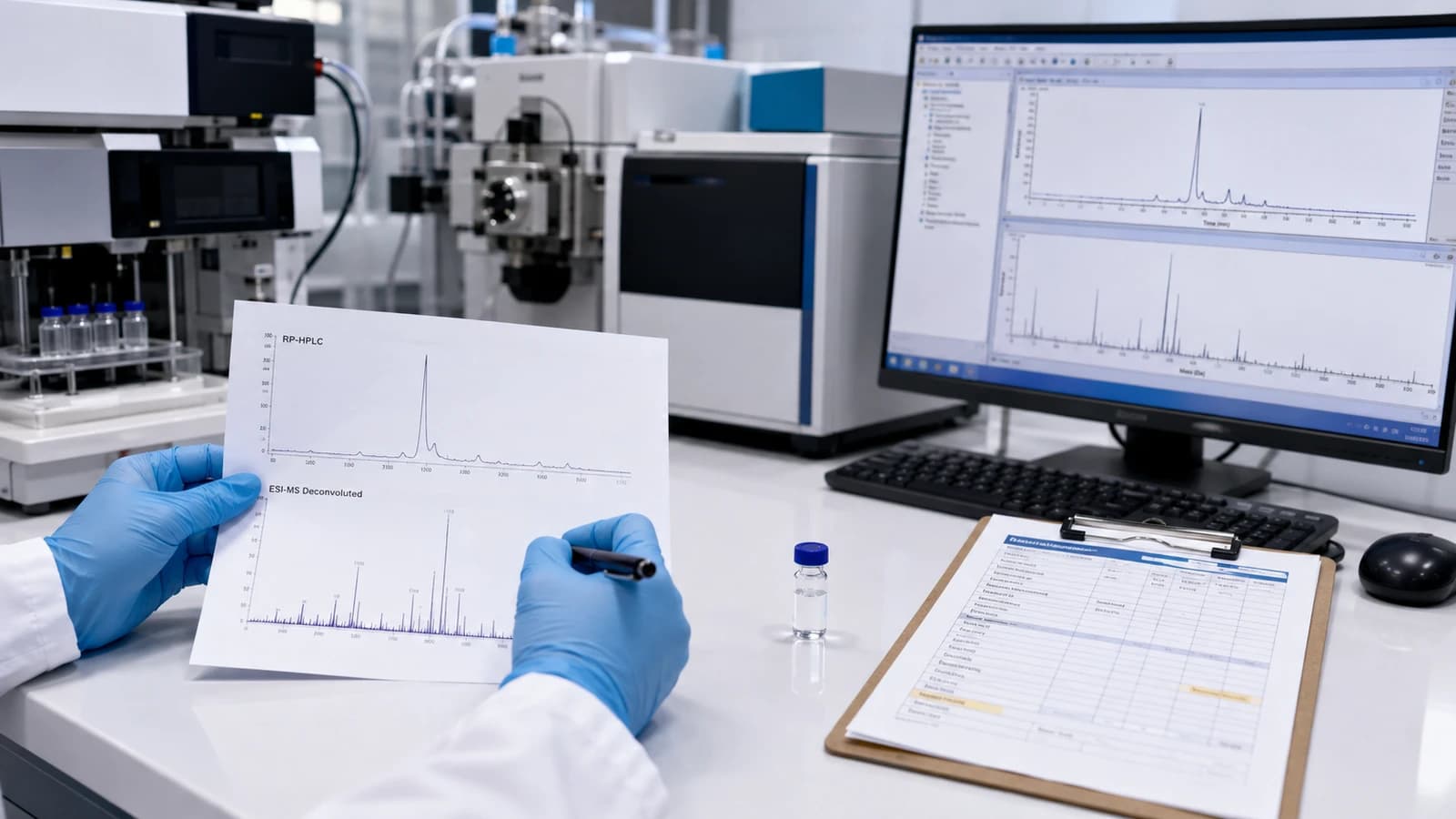
A peptide COA is credible only when lot-linked RP-HPLC demonstrates separation, ESI-MS confirms molecular identity, and quantitative assay establishes actual peptide content. Deletion sequences and epimers can co-elute beneath a deceptively clean RP-HPLC main peak. Class-A cleanroom lyophilization plus raw-data review prevents borrowed chromatograms and relabeled mass spectra detached from the shipped production lot.
On this page
- 01What a Peptide COA Can—and Cannot—Prove
- 02How Peptide Impurities Arise
- 03Evidence Ledger: Why Orthogonal Testing Matters
- 04Method Math: Dilution, Linearity & System Suitability
- 05Raw-Data Triage: A 10-Minute Document Review
- 06Fraud & Failure-Mode Matrix
- 07Commercial Supply Chain Forensics: Mitigating borrowed chromatograms and relabeled mass spectra detached from the shipped production lot
- 08Final Batch-Release Scorecard
1. What a Peptide COA Can—and Cannot—Prove
Mechanism:
A certificate of analysis is a summary of test results against a specification for one defined lot. It is not, by itself, proof that the tested sample came from the vials delivered to the buyer. A credible peptide COA must connect five objects without a broken link: purchase order, production lot, submitted analytical sample, raw instrument files, and shipped finished units. If the lot identifier on the vial cannot be traced to the identifier in the chromatographic sequence, the document may describe real science performed on someone else’s material.
The first audit error is treating “purity” as a universal number. RP-HPLC area percent reports the relative detector response assigned to chromatographic peaks under one method. It does not directly establish the mass of peptide in a vial. It does not detect every non-UV-active component, prove sterility, quantify bacterial endotoxin, identify the main peak, or show that the sequence and side-chain architecture are correct. A vial could show 99.2% chromatographic purity yet contain less active peptide than declared because water, buffer, counter-ions, or an underfill contribute to the cake or because the calibrated content assay was never performed.
The second error is asking mass spectrometry to answer the wrong question. An intact ESI-MS mass close to the theoretical value supports molecular identity, but a typed number on a PDF is not raw evidence. The reviewer needs the charge-state envelope, deconvolution settings, observed mass, mass error, acquisition date, sample identifier, and preferably the underlying data export. Isobaric substitutions, epimers, and co-eluting deletion products may require tandem MS, peptide mapping, high-resolution acquisition, or an orthogonal separation. Modern LC-MS control strategies therefore begin with the impurity risks created by synthesis, purification, formulation, and storage rather than assuming one scan resolves everything [1].
The third error is accepting a polished template as laboratory provenance. Logos, signatures, QR codes, and a “GMP” footer can be copied. The defensible signals are harder to forge consistently: instrument sequence naming, method version, reference-standard lot, system-suitability results, sample preparation, integration audit trail, analyst and reviewer timestamps, and numerical agreement between summary and raw files.
Mechanism Summary: RP-HPLC addresses separation and relative peak area, ESI-MS addresses molecular identity, and a calibrated assay addresses actual content; no single result substitutes for the other two.
Key Procurement Takeaway: Do not release a lot from a “≥99% purity” headline; require 1 lot number to bind the vial label, raw HPLC sequence, mass-spectrum sample, and signed COA.
2. How Peptide Impurities Arise
Synthetic peptide risk begins before the analytical laboratory. In solid-phase peptide synthesis, each deprotection and coupling step can leave a small fraction of chains incomplete. Across a long sequence, those small inefficiencies accumulate into deletion sequences, truncated chains, or adducts. Racemization can create an epimer with the same nominal mass as the target. Oxidation can affect methionine, tryptophan, cysteine, or other susceptible residues. Asparagine and glutamine can deamidate, aspartate can isomerize, and reactive side chains can form cross-links or aggregates.
Purification removes many of these species, but separation difficulty rises when an impurity is structurally similar to the target. A deletion product may shift retention time clearly; an epimer may sit almost under the main peak. Gradient slope, column chemistry, temperature, flow, ion-pairing modifier, detection wavelength, sample load, and integration rules all affect whether the chromatogram reveals or hides that difference. Chromatographic characterization of synthetic pharmaceutical peptides therefore uses a toolbox—reversed-phase LC, size-exclusion, ion-exchange, and LC coupled to high-resolution MS—selected around the molecule and degradation pathway [2].
After purification, formulation creates a new set of risks. Residual trifluoroacetate may remain from cleavage and purification unless counter-ion exchange is performed and verified. Lyophilized material can retain water, and residual moisture can accelerate hydrolysis or aggregation during storage. An acylated peptide may adsorb to surfaces or present hydrophobic aggregates. Reconstituted or otherwise aqueous material faces a different stability clock from dry powder. A COA that reports only a main HPLC peak omits these process-relevant attributes.
An effective audit converts each vulnerability into a test. Deletion and oxidation risks become a stability-indicating chromatographic method with LC-MS characterization. Epimer risk requires selectivity beyond low-resolution intact mass. Residual TFA requires a counter-ion or residual analysis. Moisture requires Karl Fischer or another suitable water method. Underfill requires a content or fill-uniformity plan. Microbial risk requires bioburden, sterility, and endotoxin controls appropriate to the material’s intended lawful use.
Key Procurement Takeaway: For sequences longer than 20 residues, demand a molecule-specific impurity rationale covering deletion, oxidation, deamidation, epimerization, aggregation, water, and TFA rather than a 1-page generic certificate.
3. Evidence Ledger: Why Orthogonal Testing Matters
The analytical literature does not support a “one chromatogram equals quality” model. It supports layered characterization in which each method answers a bounded question. The three sources below address complementary parts of the audit: chromatographic development, LC-MS impurity characterization, and the reference standard that anchors identity and quantitative value assignment.
Swipe to view all columns
| Evidence Source | Analytical Scope | Decision-Relevant Finding | Evidence Tier | Audit Application | Citation |
|---|---|---|---|---|---|
| Sharma et al., 2022 | Chromatographic characterization of synthetic pharmaceutical peptides | Peptide sameness requires evaluation of impurities, degradation products, aggregation, and method variables | Tier 2 (Moderate) | Review selectivity, recovery, column, gradient, modifier, and stability indication | [1] |
| Lian et al., 2021 | LC-MS characterization of synthetic peptide therapeutics | Structural isomers, stereoisomers, process impurities, and quantitation require risk-based MS workflows | Tier 2 (Moderate) | Match impurity classes to intact mass, HRMS, MS/MS, and orthogonal separation | [2] |
| Wu et al., 2023 | Reference standards for synthetic peptide therapeutics | Identity, purity, strength, content uniformity, vialing, lyophilization, and stability depend on characterized standards | Tier 2 (Moderate) | Verify standard lot, value assignment, storage, and traceability before accepting quantitative results | [3] |
These are methodological publications rather than randomized clinical trials, so “Tier 2” here describes strong technical relevance, not clinical efficacy. Their common theme is measurement fitness. An HPLC method optimized for release purity may not quantify absolute content. An LC-MS method capable of confirming intact mass may not resolve an epimer. A reference standard assigned by peak-area normalization alone may carry an incorrect mass fraction if water, salts, and nonchromophoric components are ignored.
For a buyer, orthogonality means the evidence should fail differently. If RP-HPLC shows one major peak and ESI-MS shows the wrong intact mass, identity fails. If identity is correct but quantitative assay shows 82% of declared fill, content fails. If both pass but endotoxin exceeds the applicable specification, the lot still fails. Agreement among independent methods is more persuasive than three documents derived from the same copied result.
A strong COA also separates specification from observation. “NLT 99.0%” is the acceptance limit; “99.37%” is the reported result. “Conforms” without the observed value prevents trend analysis. Likewise, “mass confirmed” should not replace the expected mass, observed deconvoluted mass, allowed tolerance, and result. Without those fields, the buyer cannot distinguish a narrow acceptance rule from analyst discretion.
Key Procurement Takeaway: Require at least 3 orthogonal result classes—chromatographic purity, molecular identity, and quantitative content—before accepting any lot represented as ≥99% peptide.
4. Method Math: Dilution, Linearity & System Suitability
Analytical preparation math is a frequent source of apparently “scientific” but internally impossible COAs. The auditor should reproduce every dilution from weighed mass, volumetric step, standard potency, and final injection concentration. A certificate that says a 1.0 mg/mL standard was prepared from 10 mg in 10 mL is incomplete if the reference standard is only 87.4% peptide by mass after correction for water and counter-ion.
The basic formula is corrected concentration = weighed mass × assigned potency ÷ final volume. Serial dilutions should conserve mass, and the reported calibration range should bracket the sample result. The following training matrix shows transparent calculations; it is an analytical workflow, not a reconstitution or human-use protocol.
Swipe to view all columns
| Preparation Stage | Nominal Input | Correction / Dilution | Calculated Concentration | Audit Check |
|---|---|---|---|---|
| Reference stock | 10.00 mg standard in 10.00 mL | Assigned peptide content 92.0% | 0.920 mg/mL | Use assigned content, not gross powder mass |
| Working standard | 1.00 mL stock to 10.00 mL | 10-fold step-up dilution | 0.0920 mg/mL | Pipette and flask classes must be recorded |
| Sample solution | 5.00 mg vial content to 5.00 mL | No potency correction before assay | 1.000 mg/mL nominal | Result must be back-calculated against calibration |
| System check | Six replicate standard injections | Peak-area precision | RSD target ≤1.5% | Failure invalidates subsequent sequence interpretation |
Method lifecycle language matters. The starting method should define intended purpose: identity, assay, purity, or impurity limit. A step-up in sample load may reveal overload and hidden shoulders but cannot be substituted silently for the validated concentration. Maintenance includes column-history controls, lamp checks, mass calibration, reference-standard monitoring, and documented method versions. An off-cycle instrument after maintenance, source cleaning, column replacement, or software update needs suitability confirmation before reportable samples resume.
For HPLC, system suitability commonly includes retention-time precision, peak-area precision, tailing, plates, and resolution for a critical pair. A tailing factor of 0.95–1.20 may be a useful internal target for a defined method, but it is not a universal pharmacopoeial rule for every peptide. More important is whether the method separates the target from the nearest relevant impurity. If that pair’s resolution is absent, a symmetrical main peak can still conceal co-elution.
Mass accuracy also needs units and method context. A tolerance stated in daltons behaves differently across molecular sizes than a parts-per-million tolerance. Multiply charged ESI ions must be correctly assigned before deconvolution. Sodium or potassium adducts and common solvent adducts should be interpreted, not deleted from the image. When a report shows only the theoretical mass and a green checkmark, no measured value has been audited.
Key Procurement Takeaway: Recalculate every standard and sample dilution to 4 significant figures and reject a sequence when system-suitability RSD exceeds 1.5% or the calibration range does not bracket the result.
5. Raw-Data Triage: A 10-Minute Document Review
Clinical Triage:
The fastest reliable review begins outside the graph. Compare the COA lot number, vial label, test request, sample sequence, and shipping documents character by character. Confirm that test and review dates follow manufacture and precede release. Check whether the analyst and reviewer are distinct where the quality system requires independent review. Look for method and specification version numbers; a result cannot be judged against a moving acceptance rule.
Then inspect the chromatogram. The file should show a full time axis, detector channel, sample name, injection number, acquisition time, method, and integration marks. Cropping just before or after the main peak can hide early polar or late hydrophobic impurities. Manual integration is not automatically wrong, but it should be visible in an audit trail with a reason. Confirm that blank, standard, suitability, and sample injections appear in a plausible sequence. Repeatedly identical baseline noise across different lots is a strong signal that an image has been reused.
Sample handling can explain subtle inconsistencies. A refrigerated reference should reach controlled room temperature when the method requires it before weighing or volumetric preparation, preventing condensation and density surprises. Autosampler needle depth must match vial geometry so the instrument does not sample air or sediment. Analysts should not rotate vials between unlabeled racks without a documented position map. These details sound mundane; they are where chain-of-custody and carryover errors often originate.
For ESI-MS, inspect both raw and deconvoluted views. The raw spectrum should contain a coherent series of charge states whose spacing supports one molecular mass. The deconvolution should state the algorithm and mass range. Check whether the acquisition date, sample identifier, and instrument are consistent with the COA. If the main spectrum is pasted into a PDF without axes or metadata, request the vendor-neutral export or original data package.
Reference standards require equal attention. Research on synthetic peptide standards emphasizes that identity, assigned content, uniformity, lyophilization, storage, and stability all support the final value [3]. A standard that expired before the run or lacks content assignment can make a precise calibration line precisely wrong. The laboratory should record the standard lot, potency correction, opening date, storage, and qualification route.
Finally, read the negative space. If the COA claims sterility but lists no method, incubation conditions, or result date, the claim is incomplete. If endotoxin is “pass” with no limit or units, the buyer cannot compare it with a <0.5 EU/mg specification. If TFA is described as “removed” but no counter-ion method appears, the conclusion is unsupported. Audit what is omitted as carefully as what is printed.
Clinical Warning: A PDF showing 99.8% RP-HPLC and a matching theoretical mass does not establish sterility, endotoxin control, actual vial content, or suitability for human use.
Key Procurement Takeaway: Complete the lot-ID, raw-file, standard-expiry, blank, suitability, full-baseline, and reviewer check before spending more than 10 minutes interpreting a peak.
6. Fraud & Failure-Mode Matrix
Fraud detection works best as a consistency test, not an aesthetic judgment. A poor-looking report can contain valid raw data; a beautiful report can be assembled from unrelated files. The matrix below maps recurring warning signs to confirmatory requests and release decisions.
Swipe to view all columns
| Warning Signal | Likely Failure Mode | Confirmatory Request | Release Decision |
|---|---|---|---|
| Same chromatogram shape and baseline across multiple lots | Borrowed or recycled raw data | Original sequence, audit trail, injection timestamps, file hashes | Quarantine until lot-specific provenance is proven |
| HPLC ≥99% but no observed mass | Purity substituted for identity | Raw ESI-MS charge envelope and deconvoluted mass | Identity incomplete; do not release |
| Correct mass but no impurity separation | Isobaric, epimeric, or co-eluting impurity missed | Stability-indicating LC, HRMS/MS, or orthogonal separation | Method suitability incomplete |
| “10 mg” derived from cake weight | Water, salt, buffer, or excipient counted as peptide | Calibrated content assay and water/counter-ion results | Fill claim unsupported |
| Endotoxin “PASS” without value or units | Undefined acceptance limit | Numeric result, method, dilution, interference control, specification | Safety attribute incomplete |
| Lab name differs between signature, report, and raw file | White-label certificate or altered template | Direct laboratory verification using report ID and sample receipt | Hold for provenance investigation |
Compatibility also matters at the document level. A COA for raw API is not interchangeable with a finished-vial release certificate. Bulk purity may be valid while filling, lyophilization, container closure, sterility, or content uniformity remain untested. Similarly, a third-party identity report does not become a manufacturer batch record. Buyers should label each document by role and avoid merging claims across stages.
The corrective action is a controlled evidence request. Ask for raw files, not a revised screenshot. Ask the named laboratory to confirm report ID and sample metadata through a known contact channel. Compare the test sample’s receipt weight and date with the production and shipment timeline. Re-test randomized units from the received shipment when risk warrants it. If a supplier responds by issuing a visually different COA without explaining the inconsistency, the audit trail has weakened rather than improved.
Compatibility Warning: Never attach a raw-API COA to finished lyophilized vials as if it proves fill content, sterility, endotoxin, container closure, or final-lot uniformity.
Key Procurement Takeaway: Quarantine a lot after 2 independent provenance mismatches and release it only when lot-specific raw files or an independent retained-sample test resolves both discrepancies.
7. Commercial Supply Chain Forensics: Mitigating borrowed chromatograms and relabeled mass spectra detached from the shipped production lot
Procurement Safeguard:
Molecule-Specific Sourcing Failure Chain:
Biochemical vulnerability — Deletion sequences and epimers can co-elute beneath a deceptively clean RP-HPLC main peak
Grey-market adulteration trap — borrowed chromatograms and relabeled mass spectra detached from the shipped production lot
Analytical verification rule — match raw LC-MS charge envelopes and retention data to lot-linked reference standards
Clinic risk impact — false batch release propagates fill errors, failed assays, complaints, and regulatory exposure
For clinics, medspas, resellers, and laboratory buyers, the fear is not an ugly chromatogram. It is a complaint storm triggered by inconsistent fill, a grey-market substitution that passes visual inspection, or a shipment that creates customs seizure and domestic regulatory exposure. Those failures compound: weak lot traceability prevents root-cause investigation; weak root-cause evidence prevents confident replacement; delayed replacement breaks supply continuity.
LeewayGo’s commercial cost stack uses a $12–$18 primary synthesis baseline, $25–$30 after export-broker handling, $60–$90 after domestic rebranding, and $150–$300 at clinic retail. The ranges illustrate where a 300%–500% markup can accumulate; they are not a universal price quote for every molecule, strength, test panel, destination, or legal route. The meaningful comparison is scope-adjusted: synthesis, purification, fill, lyophilization, independent testing, packaging, documents, freight, duty, and clearance should be separated before deciding whether an offer is genuinely cheaper.
- Margin insulation: Factory-direct supply exposes the $12–$18 baseline and separates real analytical services from anonymous broker margin.
- Proof ownership: Batch-linked RP-HPLC, ESI-MS, content, TFA, water, and endotoxin records travel with the lot instead of a generic sales folder.
- Validation control: A 10-vial low MOQ lets the buyer select received units for independent verification before expanding volume.
- Supply security: Guaranteed door-to-door DDP customs clearance defines responsibility for freight, duty, routing, and customs handling through delivery.
The value proposition is not “cheap COA included.” It is the ability to test the whole evidence chain at low exposure. A 10-vial validation lot gives procurement a practical sample for appearance inspection, unit selection, document matching, and independent laboratory confirmation. If the lot fails, the buyer has limited inventory risk. If it passes, the same acceptance packet becomes the baseline for recurring supply and trend comparison.
Class-A cleanroom freeze-drying, full batch COA, custom lyophilization, private label, and DDP air freight are meaningful only when their records remain linked. A cleanroom claim should map to the filling or lyophilization operation actually used. DDP logistics should preserve lot labels and temperature or handling requirements. Factory-direct supply should provide a named deviation path when a result is out of specification. Zero middleman markup without traceability is merely a lower price; with traceability, it becomes margin protection and supply security.
Key Procurement Takeaway: Use a 10-vial validation order to audit all 4 links—production lot, raw data, finished units, and DDP shipment—before moving from $25–$30 testing exposure toward bulk volume.
8. Final Batch-Release Scorecard
A repeatable release decision needs a scorecard that separates critical failures from negotiable documentation gaps. Identity, provenance, and applicable microbial safety are critical. A wrong mass, unrelated lot, unverifiable laboratory report, failed sterility test, or endotoxin result above the defined limit should not be averaged away by excellent packaging. Administrative formatting defects may be corrected, but the original and corrected versions should remain in the audit trail.
Start with provenance. Confirm manufacturer lot, finished-vial lot, sample ID, laboratory accession, raw-data filename, and shipment carton. Then validate method fitness: intended use, version, specificity, range, accuracy, precision, and system suitability. ICH Q2(R2) frames validation around whether an analytical procedure is fit for its intended purpose; the same logic prevents a release-purity method from being stretched into identity or absolute assay without evidence.
Next review the results as independent layers. RP-HPLC should report full chromatographic data and ≥99% purity where that is the agreed specification, with the main peak and relevant impurities resolved. ESI-MS should show the raw isotopic or charge-state information and the deconvoluted mass within a justified tolerance. Quantitative content should correct for reference-standard assignment and distinguish peptide from water, salts, and excipients. TFA counter-ion exchange should be verified when claimed. Endotoxin should carry a numeric result and unit, such as <0.5 EU/mg when that release limit is appropriate. Sterility, residual solvents, water, appearance, pH, and fill uniformity should be included according to product stage and lawful intended use.
Trend analysis turns one audit into supplier control. Record retention time, purity, main impurity, observed mass, peptide content, water, fill variation, and endotoxin across batches. Define alerts before the data arrive. An RSD <1.5% for a specified quantitative system-suitability measure supports reproducibility, but the scorecard must name the measure and number of replicates. Retention sample re-testing at planned intervals helps distinguish manufacturing drift from storage failure and supports complaint investigations.
The final approval packet should be exportable and independently readable. It needs the signed COA, specifications, raw chromatograms, mass spectra, reference-standard information, calculations, deviations, reviewer disposition, and shipment linkage. Hashes or immutable storage can help show that raw files were not silently replaced. A QR code is useful only if it resolves to a lot-specific record whose revision history is controlled.
Batch Acceptance Fingerprints:
- Full RP-HPLC method and uncropped chromatogram showing ≥99% purity against the agreed specification.
- Raw and deconvoluted ESI-MS with observed mass, charge envelope, sample ID, and acquisition metadata.
- Quantitative peptide content corrected for reference-standard value, water, counter-ion, and excipient contribution.
- RSD < 1.5% for the named suitability measure plus retention sample re-testing under a defined schedule.
Key Procurement Takeaway: Final release requires 100% lot-ID parity, ≥99% RP-HPLC where specified, justified ESI-MS mass tolerance, quantitative content, and numeric endotoxin evidence—not a composite “PASS” badge.
Choose the right sourcing path
Factory-direct access for trial validation and commercial scale, backed by batch documentation and DDP delivery.
Resellers / Individuals
Low MOQ Factory-Direct Trial
Order 10+ Vials at Factory Pricing, Ready-to-Ship Inventory
Start a Trial OrderClinics / Bulk Buyers
Tier-1 Commercial Wholesale & Private Label
Full Batch COA, Custom Lyophilization, DDP Air Freight
Request Commercial QuoteFrequently asked questions
Does 99% HPLC purity mean a vial contains 99% of the labeled peptide amount?
No. HPLC area percent is a relative chromatographic measurement under a defined method. Actual peptide content requires a quantitative assay using a characterized reference standard and corrections for water, counter-ions, salts, and excipients.
How can a buyer detect a borrowed or recycled peptide COA?
Match lot and sample identifiers across labels, raw sequences, spectra, invoices, and shipment records. Compare baseline noise and file metadata across lots, request original raw files, and verify the report directly with the named laboratory through an independent contact channel.
Why are RP-HPLC and ESI-MS both required?
RP-HPLC evaluates separation and relative peak area, while ESI-MS supports molecular identity. A clean chromatographic peak can belong to the wrong molecule, and a correct intact mass can miss an epimer or co-eluting impurity, so orthogonal evidence is required.
What should be checked with a 10-vial factory-direct trial order?
Select units from the received shipment and verify lot linkage, appearance, fill content, ≥99% RP-HPLC purity where specified, ESI-MS identity, water, TFA or counter-ion status, endotoxin, packaging, and document consistency before approving recurring volume.
Does DDP customs clearance prove product compliance or quality?
No. DDP defines delivery, duty, and customs-handling responsibilities through the destination. It improves logistics predictability but does not replace analytical release testing, change regulatory status, or remove the buyer’s destination-country compliance obligations.
Clinical & technical references
View 3 cited sources
- 1.
Characterization of Synthetic Peptide Therapeutics Using Liquid Chromatography-Mass Spectrometry: Challenges, Solutions, Pitfalls, and Future Perspectives. Journal of the American Society for Mass Spectrometry, 2021. PubMed
- 2.
Synthetic pharmaceutical peptides characterization by chromatography principles and method development. Journal of Separation Science, 2022. PubMed
- 3.
Reference Standards to Support Quality of Synthetic Peptide Therapeutics. Pharmaceutical Research, 2023. PubMed