GHK-Cu for Hair Growth: What Has Actually Been Studied?
Direct answer
GHK-Cu has hair-growth research, including a formulated delivery system tested in mice and a small human eyebrow report. But frequently cited human follicle and scalp studies used AHK-Cu or a GHK-containing complex, not GHK-Cu alone. Check the molecule, formulation and study site before applying a result to a scalp product.
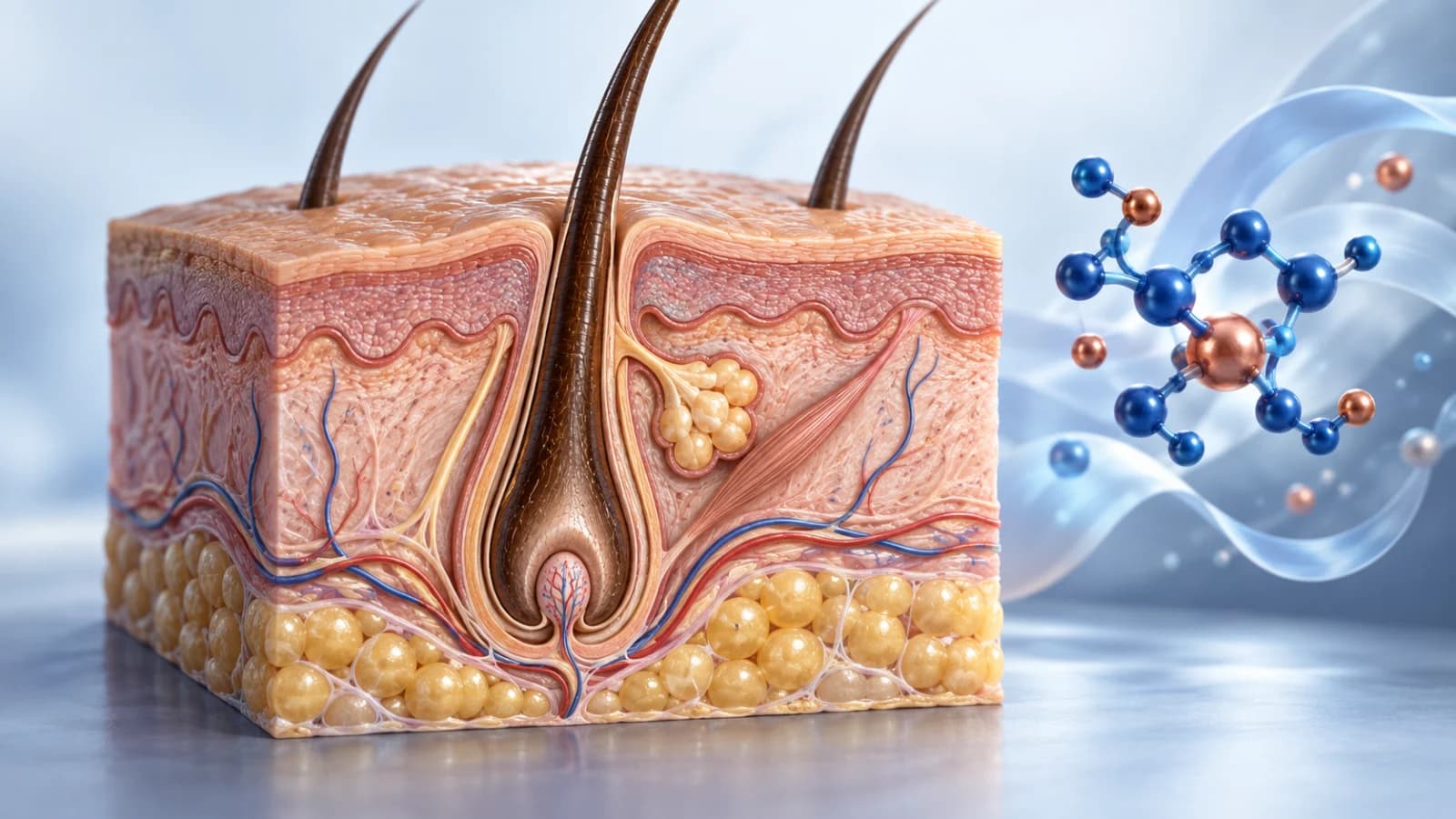
Hair-follicle and copper-peptide concept illustration; not a clinical result.
On this page
- 01The first question is not whether copper peptides work
- 02GHK-Cu, AHK-Cu and ALAVAX are not synonyms
- 03Actual GHK-Cu research: the delivery system is part of the result
- 04What the human evidence does—and does not—contain
- 05Hair count, thickness and a good photograph answer different questions
- 06From a promising ingredient to a finished formula
- 07Buying GHK-Cu without buying someone else's evidence
- 08Where GHK-Cu belongs in a serious hair-product programme
1. The first question is not whether copper peptides work
It is which copper peptide the evidence is actually about.
A brand founder researching a hair serum can quickly collect an impressive folder: human hair follicles, a controlled scalp study, molecular pathways and photographs of regrowth. The folder looks convincing until someone checks the ingredients. One experiment used AHK-Cu. Another used a GHK-containing complex. A third tested GHK-Cu inside a particular delivery system in mice.
Those are not worthless studies. They are different studies, answering different questions. The trouble starts when their names disappear and all the results become "clinical proof for GHK-Cu."
There is genuine GHK-Cu research worth examining. There is also an early human eyebrow report that deserves a place in the discussion. A serious review should include both without turning preliminary or site-specific findings into a guarantee for every scalp formulation.
Three details keep the evidence useful
- Ingredient identity: Was the experiment testing GHK-Cu, AHK-Cu, uncomplexed GHK or another compound containing GHK?
- Test setting: Were the subjects cells, isolated follicles, mice or people using a finished formulation?
- Outcome: Did investigators measure a pathway, hair-shaft elongation, hair count, calibre or a patient's assessment?
For a formulator, these distinctions affect what to develop. For a buyer, they affect what to request. For someone looking for a hair-loss treatment, they affect whether a headline speaks to their actual condition.
This article follows the ingredient through the evidence rather than collecting every paper that happens to mention copper and hair. The result is a clearer picture of where GHK-Cu is interesting, what has been tested and what a commercial development programme still needs to establish.
The identity check: A paper can be authentic and still support the wrong ingredient on your product brief. Verify the tested material before deciding how persuasive its result is.
2. GHK-Cu, AHK-Cu and ALAVAX are not synonyms
The letters describe the peptide sequence. GHK begins with glycine; AHK begins with alanine. Both names include histidine and lysine, but changing the first residue changes the molecule. Adding copper or linking a peptide to another chemical component adds another identity question.
Swipe to view all columns
| Name | What the name identifies here | Where it appears in the evidence |
|---|---|---|
| GHK | Glycyl-histidyl-lysine peptide | Part of the complex studied as ALAVAX |
| GHK-Cu | The copper complex of GHK | Microemulsion delivery research and the eyebrow report |
| AHK-Cu | The copper complex of alanyl-histidyl-lysine | A human hair-follicle laboratory study |
| ALAVAX | A complex involving 5-aminolevulinic acid and GHK | A controlled study in men with pattern hair loss |
The follicle and ALAVAX papers identify their materials explicitly. Reading those sections is more informative than relying on a product page that groups them under a broad copper-peptide label.[1][2]
A familiar name can hide a specification change
Consider a development brief that begins with GHK-Cu, then acquires an AHK-Cu reference during a literature search. The team may decide AHK-Cu is worth investigating. That is a legitimate development decision. It is not a reason to keep the original ingredient name while quietly borrowing the new ingredient's evidence.
The same discipline applies when a supplier quotes "copper peptide powder." Before discussing price, establish the precise sequence and complex being offered. A broad commercial category does not resolve that question. Nor does the colour of a sample establish that it matches the material used in a particular study.
For documentation, use the exact ingredient name in the request, formulation record, test report and supporting literature note. If the project changes ingredients, update all four. This is a small administrative step with a large scientific payoff: it prevents an accidental evidence substitution from surviving into packaging or a sales presentation.
Once identity is fixed, the next question becomes much more productive: what did the researchers actually do with that material?
3. Actual GHK-Cu research: the delivery system is part of the result
A Bioactive Materials paper published in the 2024 volume developed an ionic-liquid microemulsion for GHK-Cu. The investigators studied delivery and biological responses, including hair growth in depilated mice. The formulation involved an ionic-liquid system based on L-carnitine and tartaric acid. The work also examined signalling associated with Wnt/β-catenin and VEGF.[3]
This is directly relevant GHK-Cu research. It is not a human scalp trial, and the tested product was not simply any water-based copper-peptide serum. The engineered carrier belongs in the description of the experiment, not in the small print.
Why the vehicle deserves attention
An ingredient development project has at least two questions: can the material produce an interesting response under the tested conditions, and can the chosen formulation deliver it appropriately? A positive answer to the first does not automatically answer the second.
For a brand team, that changes the development brief. Instead of asking a manufacturer to "make the serum from the paper," ask which features of the experimental formulation are essential to the result, which can be reproduced and which require separate testing in the proposed product.
The commercial opportunity is not lost by asking these questions. It becomes more specific. Delivery can be a meaningful area of product development. A formula with a clear rationale is easier to evaluate than one whose entire technical story is an ingredient percentage on the front label.
At the same time, do not turn mechanistic findings into a guaranteed human growth rate. A pathway signal is useful for explaining what to investigate next. It does not provide a calendar telling a customer when their scalp will look different.
Keep the experiment intact: When the evidence concerns an ingredient inside an engineered carrier, the defensible description includes both. Removing the carrier from the story can remove the very feature the researchers were investigating.
For buyers, the right follow-up is therefore formulation-specific: what evidence belongs to the proposed finished product, rather than only to its most recognisable ingredient?
4. What the human evidence does—and does not—contain
Several papers commonly discussed together occupy different levels of evidence. The table makes that separation visible before looking at the results.
Swipe to view all columns
| Evidence source | Tested material | Setting | What was assessed |
|---|---|---|---|
| Pyo and colleagues, 2007 | AHK-Cu | Isolated human follicles and dermal papilla cells | Follicle elongation and cellular responses [1] |
| Lee and colleagues, 2016 | ALAVAX: 5-aminolevulinic acid–GHK complex | Six-month study enrolling 45 men | Scalp hair count, length and thickness [2] |
| Bioactive Materials, 2024 | GHK-Cu in an ionic-liquid microemulsion | Laboratory work and depilated mice | Delivery and hair-related responses [3] |
| Eyebrow report, 2026 | Reported 2% GHK-Cu serum | Eighteen adults; split-face vehicle comparison | Eyebrow count and diameter over 12 weeks |
The AHK-Cu experiment found follicle elongation and dermal papilla cell proliferation under laboratory conditions. Human tissue makes it relevant to human biology; it does not make it a trial in people applying a scalp product.[1]
The ALAVAX study reported a hair-count signal, with a significant between-group change-ratio comparison for the lower-concentration group versus placebo at six months. Hair length and thickness did not show significant between-group differences. It tested the complex, not GHK-Cu alone.[2]
The small eyebrow report belongs in the picture
A May 2026 report in Procedia of Multidisciplinary Research describes a randomised, double-blind, split-face study in 18 adults. One eyebrow received a reported 2% GHK-Cu serum and the other vehicle for 12 weeks. The abstract reports improvements in count and diameter. The original report is linked below; it is a small preliminary human report, not a large scalp trial.
That distinction changes how to describe the evidence. Saying there is no human hair-related GHK-Cu research would overlook this report. Saying that scalp regrowth is established would go beyond it. Eyebrows, scalp pattern hair loss and an isolated follicle are not interchangeable study settings.
The reported concentration describes that study formulation. It is not a recommendation to prepare a serum at home or a specification that any similarly labelled product has been shown to meet.
5. Hair count, thickness and a good photograph answer different questions
Once the ingredient and study setting are clear, check the endpoint. "Improved hair growth" can conceal several quite different observations.
A shaft may elongate in a culture experiment. An assessor may count more visible hairs in a defined area. A study may measure a change in diameter. A participant may be happier with appearance. Those outcomes can complement one another, but substituting one for another changes the claim.
Swipe to view all columns
| Outcome being discussed | What to retain in your evidence note | What still needs a separate answer |
|---|---|---|
| Hair count | Defined area, counting method and comparison group | Whether calibre or appearance also changed |
| Hair diameter | Measurement method and follow-up | Whether the number of hairs changed |
| Follicle elongation in culture | Tested ingredient and laboratory conditions | Whether a finished topical product benefits people |
| Before-and-after appearance | Consistent lighting, angle, area and assessment | Whether the change exceeds vehicle or normal variation |
Read beyond the best-performing endpoint
If a paper measures several outcomes, a product summary should not quietly imply that all improved because one did. Keep the positive result and the non-positive results together. That does not diminish a promising finding; it identifies what it actually is.
For photographs, ask what was standardised. A persuasive visual can help explain a measured change, but a new hairstyle or a different camera angle is not a measurement method. A development team should plan imaging before the first participant starts, not choose whichever pair of photographs looks strongest afterwards.
The same principle applies to time. A follow-up period tells you when investigators measured an outcome. It does not automatically establish the first day of benefit, how long any benefit lasts or what happens after discontinuation. Those are different questions requiring the relevant observations.
Clinical Warning: An ingredient review cannot determine the cause of an individual's hair loss. Persistent, sudden or otherwise concerning hair changes need clinical assessment rather than a product choice made from a laboratory result or a photograph.
For brands, an endpoint-specific explanation can be more persuasive than an expansive claim. It gives an informed customer something concrete to evaluate and avoids a promise that the supporting paper never tested.
6. From a promising ingredient to a finished formula
The gap between an ingredient and a product is not just packaging. It includes the vehicle, the behaviour of the ingredient in that vehicle, the conditions of storage and the way the product will actually be used.
An in-vitro human-skin penetration study illustrates a measurement issue worth remembering. The researchers applied a copper-tripeptide preparation and quantified copper using ICP-MS. Copper detected across a skin model is not, by itself, a molecule-specific measurement of intact GHK-Cu, and the experiment did not measure hair regrowth in users.[4]
Ask what the assay can see
For your own project, distinguish total copper, peptide identity and the intact complex wherever the chosen methods allow. A method may answer one question well without answering the others. The point is not to dismiss a result because it is incomplete; it is to avoid assigning it a conclusion outside its scope.
That distinction also helps when testing stability. A sample may retain a familiar appearance while other attributes change. Conversely, a visible change may prompt an investigation without identifying the chemical cause. Define the acceptance criteria and the methods before deciding what a visual observation means.
Build the development sequence around decisions
- Identify the material: Confirm which peptide and complex the project is using before comparing literature.
- Define the vehicle: Record the complete formulation being evaluated, not only its headline active.
- Set the endpoint: Choose a measurable question and an appropriate comparator before collecting results.
- Keep the version history: If the vehicle or active changes, do not let the earlier evidence silently follow the new version.
These steps do not require every early experiment to become a large clinical programme. They require each experiment to have a clear purpose. A pilot might screen candidate vehicles. A stability study might decide whether a pack and formulation remain suitable over the proposed period. A human study would answer a different set of questions.
For a private-label buyer, ask which of those steps have actually been completed for the offered formula. "Contains a studied ingredient" is useful background. It is not the same deliverable as finished-product evidence.
7. Buying GHK-Cu without buying someone else's evidence
The sourcing problem in this category is unusually specific: evidence can be switched more easily than ingredients. A quotation for GHK-Cu arrives with an AHK-Cu follicle paper, an ALAVAX scalp result and a generic statement about copper. Every attachment may be real, yet the package still does not establish what the buyer thinks it does.
The answer is not to demand a thicker folder. It is to request a more precise one.
Put ingredient identity ahead of the price comparison
Ask for the exact material designation and the basis of the quoted quantity. Establish whether you are buying a raw ingredient, a premix or a finished formulation. If a seller cites a finished-product study, ask whether the offered material or formula is actually the one tested.
For a raw-material evaluation, make the sample traceable to its documentation and record how it is used in your own formulation. If the project later moves to a different batch, vehicle or pack, retain that change in the development record. A successful pilot is most useful when the team can explain what it would need to reproduce.
LeewayGo supplies factory-direct material for formulation and research evaluation, with Tier-1 wholesale pricing, verified ≥99% HPLC/MS purity and low-MOQ testing. The 10-vial pilot route lets a team evaluate a defined material before committing to a larger order. Ask for the specification and documentation that match your intended project, rather than borrowing a specification from a hair-growth headline.
For international buyers, include the destination and required documents when requesting door-to-door DDP supply. Price, order size and delivery responsibility should be explicit in the quotation. DDP describes the supply arrangement; it does not establish a finished formula's efficacy or local product claims.
This is where factory-direct sourcing earns its place in the article. Fewer intermediaries can make the specification discussion more direct and the evaluation order easier to organise. The commercial advantage does not require pretending that a powder certificate proves scalp regrowth. It requires delivering the right material for a development programme that knows what it is testing.
8. Where GHK-Cu belongs in a serious hair-product programme
GHK-Cu is worth investigating because there are specific questions to pursue, not because every copper-peptide result can be merged into one success story.
The most useful development brief begins with a sentence that is almost impossible to misunderstand: "We are evaluating this identified material, in this formulation, for this measured outcome, in this setting." Each phrase narrows the work enough to make the next result interpretable.
For a brand exploring a scalp product, that could mean first establishing whether the intended formula has the necessary material and stability characteristics, then designing an appropriate evaluation of the actual finished product. For a laboratory, it could mean testing a delivery or mechanistic question without pretending the experiment is a consumer efficacy study.
A short decision note is enough to start
List the ingredient, proposed product form, target study setting and the result that would justify moving forward. Add the evidence already available and the question it leaves open. If a supporting paper uses a different molecule, retain it as background and label the difference. Do not force it to answer the current project's question.
When comparing development partners, ask them to explain that gap in plain language. A strong partner can tell you which work is directly applicable, which is informative but indirect, and what should be measured next. That explanation is more valuable than a bundle of citations with no link to the proposed formula.
For a purchasing team ready to test material, send LeewayGo the exact GHK-Cu requirement, sample quantity, destination and documentation needs. For a reader choosing care for hair loss, bring treatment questions to a qualified clinician; an ingredient-sourcing page is not an individual treatment plan.
The next useful question is not "Does copper peptide work?" It is "Which molecule, in which product, produced which result?" Once that is clear, the evidence becomes easier to use—and the supply conversation becomes much harder to misdirect.
Additional sources & related reading
Includes a small preliminary 2026 eyebrow report, linked directly to its original publisher. Numbered DOI/PubMed journal references appear below the FAQ.
- 2026 eyebrow study: original report and abstract, Procedia of Multidisciplinary Research (opens in a new tab)
- GHK-Cu ionic-liquid microemulsion: full paper, including mouse experiments (opens in a new tab)
- ALAVAX scalp study: full paper and outcome tables (opens in a new tab)
- Skin penetration paper: publisher notice identifying the final version (opens in a new tab)
Continue within the Research Hub
Choose the right sourcing path
Factory-direct access for trial validation and commercial scale, backed by batch documentation and DDP delivery.
Resellers / Individuals
Low MOQ Factory-Direct Trial
Order 10+ Vials at Factory Pricing, Ready-to-Ship Inventory
Start a Trial OrderClinics / Bulk Buyers
Tier-1 Commercial Wholesale & Private Label
Full Batch COA, Custom Lyophilization, DDP Air Freight
Request Commercial QuoteFrequently asked questions
Is there any human GHK-Cu hair-growth research?
A small 2026 report describes a vehicle-controlled, split-face eyebrow study in 18 adults using a reported 2% GHK-Cu serum for 12 weeks. That preliminary eyebrow result should not be presented as a large scalp pattern-hair-loss trial. The original report is linked in the additional sources section.
Is the 2007 human hair-follicle study about GHK-Cu?
No. It studied AHK-Cu, which begins with alanine rather than glycine. It used isolated human follicles and cells, not people applying a finished scalp product. It is relevant copper-peptide research but not direct clinical proof for GHK-Cu serum.
Does the ALAVAX trial establish that GHK-Cu alone regrows scalp hair?
No. ALAVAX is a complex involving 5-aminolevulinic acid and GHK. A finding with that complex cannot establish the independent effect of GHK-Cu or of a different finished formulation.
Can these studies establish that GHK-Cu replaces an established hair-loss medicine?
The evidence reviewed here does not establish that conclusion. Different ingredients, laboratory models and a small eyebrow report should not be combined into a head-to-head scalp-treatment claim. Discuss treatment choices with a qualified clinician.
Can I order a low-MOQ GHK-Cu evaluation lot from LeewayGo?
Use the factory-direct trial inquiry to request the 10-vial pilot option and specify the exact material, quantity, destination and documentation needed. Ask for a written Tier-1 quotation and DDP delivery scope. Material qualification supports your development programme; it is not proof of a finished hair product's efficacy.
Clinical & technical references
View 4 cited sources
- 1.
The effect of tripeptide-copper complex on human hair growth in vitro. Archives of Pharmacal Research, 2007. PubMed
- 2.
Efficacy of a Complex of 5-Aminolevulinic Acid and Glycyl-Histidyl-Lysine Peptide on Hair Growth. Annals of Dermatology, 2016. PubMed
- 3.
Thermodynamically stable ionic liquid microemulsions pioneer pathways for topical delivery and peptide application. Bioactive Materials, 2024. PubMed
- 4.
Human skin retention and penetration of a copper tripeptide in vitro as function of skin layer towards anti-inflammatory therapy. Inflammation Research, 2010. PubMed