Raw Powder, Lyophilized Vials, or Premixed Serums: What Are You Actually Buying When Sourcing GHK-Cu?
Published by the LeewayGo Analytical Operations & Peptide Formulation Chemistry Team
7 min read
On this page
- 01The Chemistry of the Blue Hue: Spectroscopy vs. Commercial Dilution
- 02Physical Form Factor Breakdown: Raw Powder vs. Lyophilized Vials vs. Premixed Serums
- 03Formulation Pitfalls: Preserving Peptide Integrity
- 04Sourcing Without Guesswork: The LeewayGo Factory Standard
- 05Secure Your Factory-Direct Copper Peptide Supply
Across online skincare forums, peptide supply groups, and formulation communities—from r/Peptidesource and r/40and45PlusSkinCare to r/Biohacking—a sharp debate surfaces whenever practitioners source copper peptides: Why does a "2%" commercial copper peptide serum appear nearly colorless, while an authentic in-house formulation displays an intense, royal cobalt hue? Should aesthetic clinics, formulators, and individual practitioners buy pre-bottled cosmetics, bulk raw active powder, or vacuum-sealed lyophilized vials?
Purchasers navigating the marketplace face inconsistent labeling, arbitrary concentration metrics, and extreme pricing markups. High-street retail brands charge premium rates for diluted 1% to 3% solutions, while secondary distributors market questionable "10%" mixtures without verifiable active milligram specifications. Meanwhile, buyers attempting custom formulations disagree on whether lyophilized sterile vials or bulk cosmetic raw powders yield optimal stability and bioavailability.
At LeewayGo, we eliminate marketing ambiguity through analytical peptide chemistry, stoichiometry, and primary manufacturing transparency. Here is the unvarnished reality behind GHK-Cu coloration, true percentage calculations, and how to source the correct physical form factor for your specific operational goals.
1. The Chemistry of the Blue Hue: Spectroscopy vs. Commercial Dilution
The defining characteristic of authentic GHK-Cu (Gly-L-His-L-Lys-Cu2+) is its deep, radiant blue color. This is not an added pigment or artificial dye; it is the direct physical consequence of d-d orbital electronic transitions when cupric copper ions coordinate stoichiometrically in a 1:1 molar ratio with the nitrogen atoms of the tripeptide backbone.
Why do commercial pre-made serums look so pale compared to genuine concentrate solutions?
- The 1% Labeling Illusion (Solution Mass vs. Pure Active Milligrams): In retail skincare, marketing claims often cite "1%" or "2%" based on a proprietary blend or aqueous pre-dilution rather than pure active peptide weight. A true 1% concentration requires 10 milligrams of pure GHK-Cu per 1 gram (approx. 1 mL) of vehicle, translating to 300 mg of solid copper peptide in a standard 30 mL dropper bottle. Many commercial products include mere trace quantities—often under 0.1% active substance—relying on marketing blends that yield an almost colorless or pale sky-blue appearance.
- Chelation Saturation: When synthesized correctly, pure GHK-Cu powder and its lyophilized cake possess an intense, deep cobalt blue. In legitimate formulations above 1.5% active concentration, the solution appears distinctly vibrant blue. An almost clear "2%" formulation indicates substantial carrier dilution, inferior copper saturation, or incomplete chelation.
- The "10% Concentration" Trap: High-percentage marketing claims (such as unverified 10% topical serums) often mislead buyers. Authentic GHK-Cu exhibits a saturation ceiling where supra-physiological concentrations generate skin barrier irritation, formulation instability, and accelerated peptide cleavage without enhancing cell signaling pathways. Legitimate clinical and aesthetic benchmarks center reliably within the 0.5% to 3.0% active range.
2. Physical Form Factor Breakdown: Raw Powder vs. Lyophilized Vials vs. Premixed Serums
Choosing the correct product format depends directly on who is buying and how the peptide is handled downstream:
                            ┌──────────────────────────────────────────────┐
                            │               Pure Synthesis                 │
                            │      High-Throughput SPPS + Chelation        │
                            └──────────────────────┬───────────────────────┘
                                                   │
                   ┌───────────────────────────────┴───────────────────────────────┐
                   ▼                                                               ▼
     ┌───────────────────────────┐                                   ┌───────────────────────────┐
     │   Bulk Raw Active Powder  │                                   │ Lyophilized Sterile Vials │
     │  (Cosmetic / Formulation) │                                   │ (Cleanroom Freeze-Dried)  │
     └─────────────┬─────────────┘                                   └─────────────┬─────────────┘
                   │                                                               │
     ┌─────────────┴─────────────┐                                   ┌─────────────┴─────────────┐
     ▼                           ▼                                   ▼                           ▼
Custom Skincare            Aesthetic Clinic                    Clinical Topical             Targeted In-House
Manufacturing              Compounding Tanks                   Fresh Preparation            Immediate Protocols
Swipe to view all columns
| Parameter | Bulk Raw Cosmetic Powder | Lyophilized Sterile Vials (e.g., 50mg / 100mg) | Finished Commercial Serums |
|---|---|---|---|
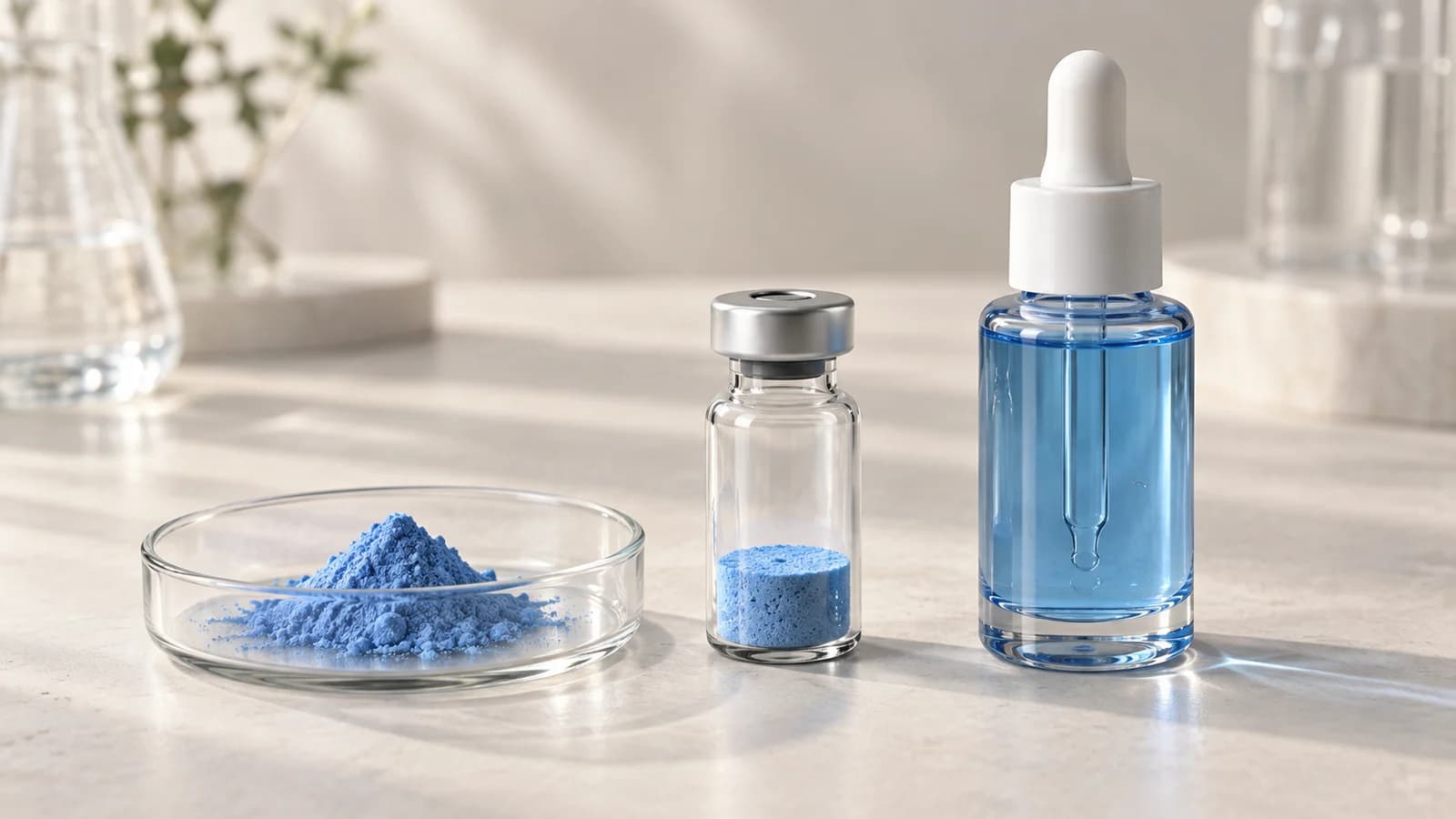
| Physical State | Free-flowing crystalline blue powder | Freeze-dried solid porous cake | Diluted aqueous / gel liquid |
| Target End-User | Manufacturers, cosmetic brands, clinics | Aesthetic clinics, aesthetic practitioners, personal buyers | Retail end-consumers, home users |
| Active Transparency | Exact weight (grams / kilograms) | Exact active milligrams per vial | Often obscure percentage claims |
| Storage Stability | Stable at -20°C; hygroscopic once opened | Vacuum-sealed under inert N2; 24+ mo stability | Limited shelf-life; exposed to oxidation |
| Cost per Active mg | Lowest manufacturing-direct unit cost | Low, scalable institutional cost | Highest (8x to 15x commercial markup) |
| Preparation Needs | Requires precision laboratory balance | Simple reconstitution via sterile diluent | Ready to use |
When to Use Bulk Raw Powder
For cosmetic formulation laboratories, aesthetic clinics producing in-house compounding batches, and contract manufacturers, purchasing bulk raw active GHK-Cu powder in gram or kilogram lots is the most cost-efficient route. It allows precise mass-to-volume compounding (e.g., adding 3,000 mg into 100 mL of hyaluronic acid base to yield a verified 3% formulation).
When to Use Lyophilized Sterile Vials
For individual practitioners, wellness clinics, and personal clients seeking ultra-fresh, single-client applications, lyophilized vials (50 mg or 100 mg cakes) represent the gold standard. Because GHK-Cu in pre-diluted aqueous solution gradually degrades when exposed to room temperature and trace atmospheric oxygen, freeze-dried vials purged with nitrogen preserve 100% of the active peptide structure until the exact moment of dilution. Reconstituting a 100 mg vial with 5 mL of hyaluronic acid serum yields an ultra-potent, completely verifiable 2% topical treatment free from degraded byproducts.
3. Formulation Pitfalls: Preserving Peptide Integrity
Regardless of whether you use bulk powder or reconstitute from sterile vials, copper peptides require precise physical chemistry handling:
- Avoid Strong Reducers and Vitamin C (L-Ascorbic Acid): Ascorbic acid rapidly reduces cupric copper (Cu2+) to cuprous copper (Cu+), dismantling the coordinate chelation cage and precipitating free copper salts. This turns the vibrant blue solution into a muddy brownish-yellow, entirely inactivating the peptide's signaling capacity.
- Maintain Neutral pH Bands (5.5--7.0): Excessive acidity protonates the imidazole rings of the histidine residues, causing dissociation of the copper ion.
- Avoid Aggressive Chelators (EDTA): High concentrations of competing chelating agents strip the copper atom away from the GHK sequence, eliminating its specific matrix-remodeling properties.
4. Sourcing Without Guesswork: The LeewayGo Factory Standard
Whether you operate an aesthetic medspa, direct a cosmetic manufacturing pipeline, manage a local reseller network, or prepare advanced personal formulations, you should never have to guess the active milligram content behind a diluted bottle.
LeewayGo provides direct primary manufacturing with uncompromising analytical verification across every form factor of LeewayGo High-Purity GHK-Cu:
- Stoichiometric 1:1 Copper Chelation: Our synthesis engineers oversee complete coordination chemistry during the aqueous chelation phase, ensuring no excess free unchelated copper ions remain to irritate the dermis, and no uncoordinated GHK tripeptide dilutes your target concentration.
- Verified Chromatographic Purity (≥ 99.0%): Every batch of bulk raw powder and lyophilized vials undergoes testing via High-Performance Liquid Chromatography (HPLC) for peak purity and Liquid Chromatography-Mass Spectrometry (LC-MS) for absolute molecular weight verification (404.9 g/mol including coordinated copper).
- Open Lot Verification: We deliver complete raw spectra—displaying baseline integration, UV absorbance profiles, and moisture levels—accessible directly on our COA Verification Portal.
- Flexible Packaging & DDP Delivery: From 50 mg and 100 mg cleanroom lyophilized vials to multi-kilogram bulk raw active drums, LeewayGo supports OEM custom packaging and white-label fulfillment, backed by fully insured, guaranteed DDP customs clearance corridors to North America, Europe, the UK, and Australia.
Secure Your Factory-Direct Copper Peptide Supply
Stop overpaying for diluted commercial serums containing unverified active fractions. Expand your technical foundation on peptide-driven tissue remodeling by exploring our technical overview at the GHK-Cu Tissue Remodeling & Scientific Synthesis Hub, or examine analytical purity benchmarks in our GHK-Cu Genomic Remodeling & Purity Guide.
Ready to secure consistent raw active materials or sterile lyophilized kits for your brand, clinic, or private supply? Request an Institutional & Wholesale Quote directly from our manufacturing desk today to unlock scalable tier pricing and dependable fulfillment.