Retatrutide Lyophilized Powder and Reconstitution Storage Evidence: What New Community Stability Tests Actually Mean for B2B Buyers and Researchers
4 min read
On this page
As research into triple-agonist peptides accelerates, procurement professionals, clinic owners, wellness operators, and independent researchers face a persistent operational challenge: maintaining peptide integrity across extended supply chains and storage cycles. Recent discussions across research communities—such as a heavily discussed thread on Reddit regarding Retatrutide degradation metrics—have brought the practical realities of peptide stability to the forefront.
While online community discussions highlight common user questions regarding handling methods—such as inquiries into baseline storage protocols for lyophilized powder—professional buyers require structured, empirical data. Independent laboratory summaries, such as the initial stability overviews outlined on Peprecon, provide valuable contextual reference points by tracking sealed lyophilized powder samples stored in light-shielded containers under standard domestic refrigeration over 14 to 21 months, alongside liquid reconstituted samples maintained at a constant 4°C and simulated thermal stress trials at 130°F.
This article examines how to interpret these stability benchmarks, what they indicate for international shipping and cold-chain management, and how commercial buyers can safeguard their inventory quality.
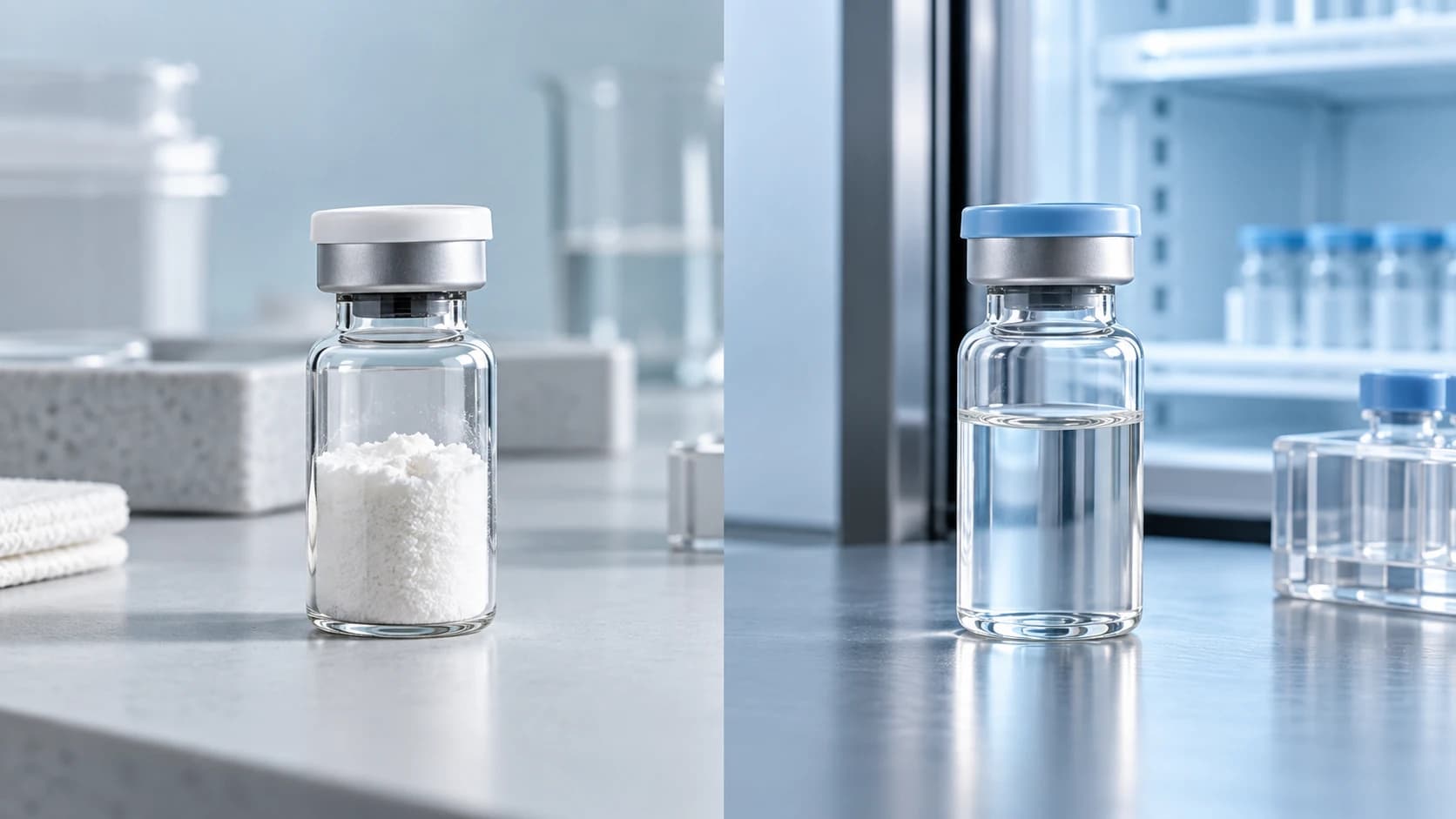
Understanding Peptide Stability: Lyophilized Powder vs. Reconstituted Solution
The structural integrity of Retatrutide—a single-peptide chain acting as a GIP, GLP-1, and glucagon receptor triple agonist—depends heavily on its physical state.
1. Lyophilized Powder (The Dry State)
Freeze-drying (lyophilization) removes water from the peptide formulation, locking the molecular structure into an amorphous cake matrix. In its dry, sealed state, protected from moisture and UV degradation, high-purity Retatrutide demonstrates robust resilience.
- Thermal Tolerance: Dry-state stability tests simulating transit conditions (including elevated temperature exposure) indicate that short-term transit variations do not instantly compromise peptide bonds.
- Long-Term Storage: Stored in a dry, dark environment at standard refrigeration temperatures (2°C to 8°C) or lower, sealed vials maintain structural purity over extended multi-month horizons.
2. Reconstituted Solution (The Liquid State)
Once bacteriostatic water or sterile water is introduced, degradation pathways—such as deamidation, aggregation, and hydrolysis—accelerate significantly.
- Thermal Sensitivity: Liquid peptides lose structural stability much faster than lyophilized powders. Constant refrigeration at 4°C is mandatory to slow enzymatic and chemical breakdown.
- Practical Window: Reconstituted solutions are designed for immediate or short-term experimental use, whereas sealed dry powder forms the bedrock of wholesale inventory management.
Supply Chain Realities: What Stability Data Means for Transit and Bulk Procurement
For importers, distributors, and research institutions managing bulk shipments, laboratory stability findings offer clear operational guidance rather than absolute guarantees for every variable.
Managing International Transit
A common concern among bulk buyers is whether express shipping fluctuations cause degradation. Empirical stress tests running elevated temperatures (such as 130°F trials) demonstrate that high-purity, vacuum-sealed lyophilized peptides withstand standard international transit windows without catastrophic structural collapse. However, professional logistics protocols continue to favor insulated packaging and temperature-monitored shipping lanes to protect sensitive compounds from prolonged thermal stress.
Batch-Specific Verification
Stability testing provides general baselines for molecular behavior under specific conditions, but it does not replace batch-specific quality control. Professional procurement requires verifying every production run. Buyers should always cross-reference supplier documentation against independent analytical reports. You can review our current testing verification protocols at our COA Verification Portal.
Strategic Sourcing for Research and Commercial Applications
When sourcing Retatrutide for laboratory evaluation, analytical testing, or wholesale distribution, establishing direct relationships with verified manufacturers ensures traceability, consistent purity, and transparent documentation.
LeewayGo provides direct access to high-purity research compounds backed by rigorous quality control standards. Explore our primary product specifications on the Retatrutide 10mg Vials Catalog Page. For a broader technical overview of triple-agonist mechanisms and structural handling, consult our comprehensive Retatrutide Research & Triple-Agonist Hub.
Are you managing bulk inventory requirements, looking for custom white-label packaging, or needing specific batch documentation? Submit your inquiry directly through our Wholesale Quote Request Portal.
Conclusion
Navigating peptide procurement requires separating online anecdotal discussions from verifiable laboratory data. While community forums highlight ongoing interest in handling parameters, empirical insights from analytical studies—such as those tracking long-term dry storage and controlled refrigeration—provide a reliable framework for storage and logistics. By prioritizing verified COAs, proper cold-chain transit, and strict dry-state storage, researchers and commercial buyers can ensure maximum integrity across their supply chains.