Peptide OEM & Private Label: Custom Lyophilization, Filling and Release
Direct answer
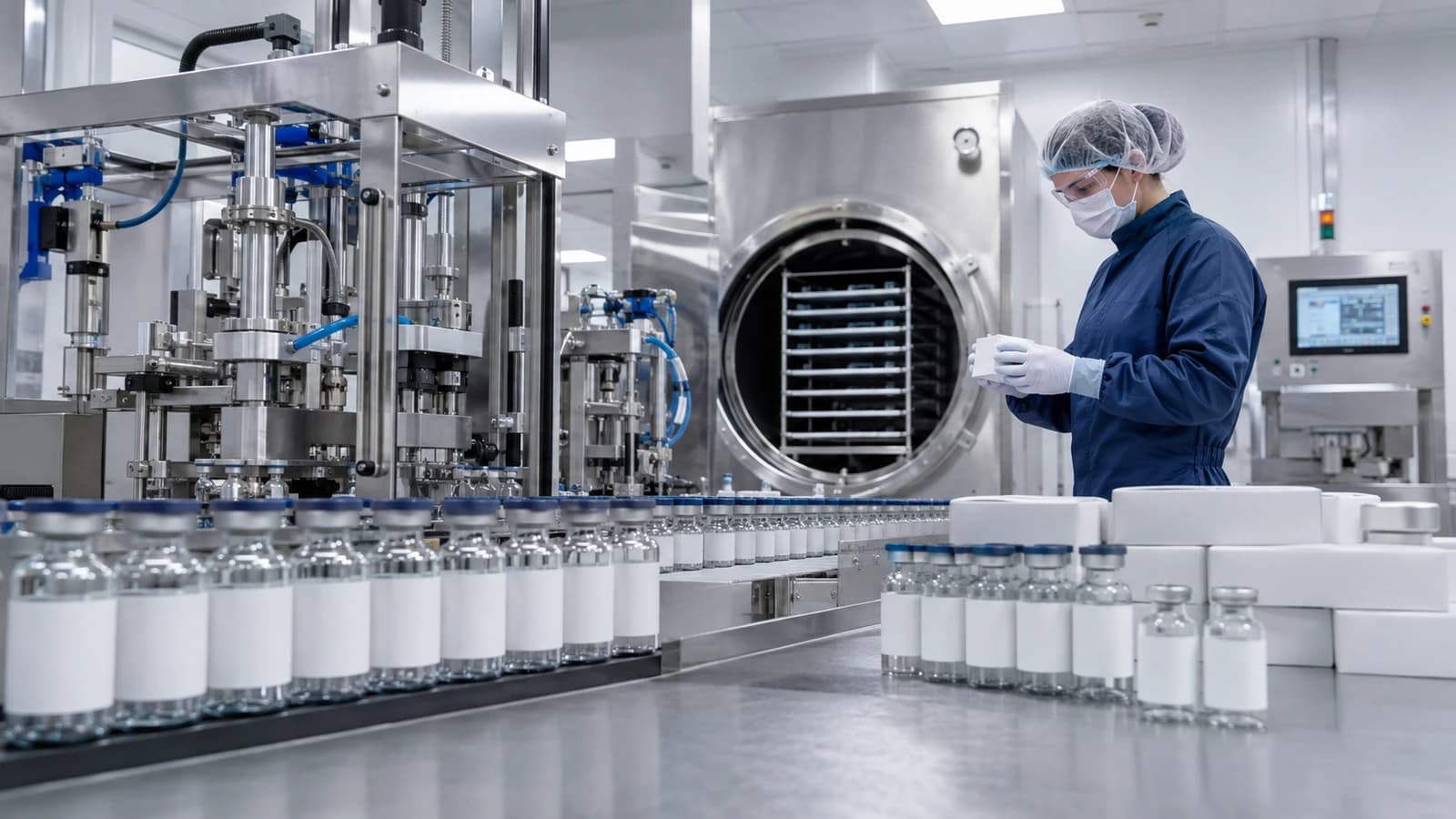
A reliable peptide OEM program transfers one controlled specification through synthesis, purification, sterile filling, lyophilization, labeling, testing, and shipment. Vial heat-transfer heterogeneity can push edge units above collapse temperature during scale-up. Class-A cleanroom lyophilization with shelf-mapped release testing prevents pilot-cycle certificates reused for commercial lots with unqualified fill and drying geometry.
On this page
- 01The OEM Product Is a Controlled System
- 02From Custom Synthesis to Scalable Fill-Finish
- 03Evidence Ledger: Peptide Control and Lyophilization Scale-Up
- 04Fill-Weight and Formulation Math
- 05Aseptic Operations, Inspection & Deviation Triage
- 06OEM Responsibility & Compatibility Matrix
- 07Commercial Supply Chain Forensics: Mitigating pilot-cycle certificates reused for commercial lots with unqualified fill and drying geometry
- 08Final OEM Audit & Launch Gate
1. The OEM Product Is a Controlled System
Mechanism:
Private label is often described as a label-and-box service. For peptides, the real product is a linked control system: sequence and modifications, raw-material specification, synthesis route, purification, counter-ion state, bulk concentration, sterile filtration or aseptic handling, fill volume, vial and stopper, lyophilization cycle, in-process controls, release methods, artwork, serialization or lot coding, and distribution.
Each transfer creates an opportunity for drift. A sequence can be correct while the wrong salt is used. Bulk solution can meet purity while fill content varies. A visually elegant cake can contain excess residual moisture. A finished vial can pass identity but fail sterility or endotoxin. A correct COA can be attached to the wrong label version. OEM governance prevents these attributes from separating.
Synthetic-peptide manufacturing adds characteristic impurities. Incomplete couplings produce deletion sequences; deprotection and cleavage can create side reactions; oxidation, deamidation, epimerization, aggregation, and residual solvents may arise during production or storage. Regulatory and scientific reviews emphasize structure, physicochemical characterization, in-process control, impurities, aggregates, and risk assessment as connected quality elements [1]. A supplier offering only a final HPLC percentage has not shown process understanding.
The specification should distinguish drug substance, bulk formulated solution, and finished lyophilized unit. Drug-substance testing may include identity, purity, related substances, assay, water, counter-ion, and residual solvents. Finished-unit testing adds appearance, reconstitution, fill content, uniformity, particles, container closure, sterility, endotoxin, and packaging reconciliation as applicable. One document cannot automatically stand in for all three stages.
Custom strengths require formulation work, not arithmetic alone. Raising peptide mass can alter concentration, freezing behavior, collapse temperature, drying resistance, reconstitution time, adsorption, and aggregation. Changing from 2 mg to 50 mg while keeping one cycle may be possible for a robust formulation, but it needs evidence across the proposed range.
Mechanism Summary: Peptide OEM quality emerges from controlled transfer of molecular identity, formulation, fill, drying, release, and label data; failure at any interface can invalidate the finished lot.
Key Procurement Takeaway: Approve no OEM launch until 1 master specification links sequence, salt, vial, stopper, fill, cycle, methods, artwork, and DDP shipment identifiers.
2. From Custom Synthesis to Scalable Fill-Finish
An OEM program begins with a quality target product profile. The buyer defines lawful intended use, sequence, modification, counter-ion, purity, content, presentation, packaging, geography, test panel, and acceptance criteria. The manufacturer converts those requirements into process and analytical controls. Ambiguous requests such as “10 mg, 99%” are inadequate because 10 mg can mean gross powder, peptide base, salt form, or nominal fill.
Solid-phase peptide synthesis is developed around resin, protecting groups, coupling reagents, equivalents, reaction monitoring, cleavage, and workup. Preparative chromatography then separates the target from deletion and process impurities. Fractions are pooled under defined criteria, concentrated, exchanged into the intended counter-ion when required, and characterized before formulation.
Formulation development chooses buffer, pH, bulking agent, stabilizer, surfactant, concentration, and fill volume. Thermal characterization helps identify critical temperatures. The lyophilization cycle then coordinates freezing, primary drying, and secondary drying. Industry reviews show that formulation, excipients, solvent system, vial geometry, fill volume, equipment, and scale-up all affect cake quality and moisture [2].
Scale-up is not copying shelf temperature and chamber pressure from a small dryer. Manufacturing equipment differs in shelf behavior, condenser capacity, gas flow, radiation, and vial heat transfer. A cycle should preserve product temperature below the relevant critical limit with sufficient margin while completing primary drying efficiently. Secondary drying must reduce bound water without driving chemical degradation.
After drying, stoppering under vacuum or inert gas, capping, inspection, labeling, cartoning, and reconciliation complete the lot. Artwork control is a quality process: product name, strength, lot, dates, storage, research-use statement, barcode, and destination language must come from an approved version. Obsolete artwork should be physically and electronically controlled.
The historical shift is from craft production to lifecycle verification. Modern OEM buyers need development reports, executed batch records, deviations, analytical raw data, stability plans, and change control. A sample that looked good once is not a manufacturing platform.
Key Procurement Takeaway: Require at least 3 engineering or validation lots before treating a custom strength and cycle as reproducible commercial supply.
3. Evidence Ledger: Peptide Control and Lyophilization Scale-Up
The evidence base combines peptide-specific quality analysis with freeze-drying engineering. These publications do not certify a particular factory; they define the technical questions an OEM partner should be able to answer.
Swipe to view all columns
| Evidence Source | Scope | Decision-Relevant Finding | Evidence Tier | OEM Application | Citation |
|---|---|---|---|---|---|
| Wu et al., 2017 | Synthetic peptide quality and regulatory parity | Structure, impurities, aggregates, manufacturing controls, and storage risks must be characterized | Tier 2 (Moderate) | Build API and finished-product specifications around molecule-specific risks | [1] |
| Butreddy et al., 2020 | Lyophilization development and scale-up | Formulation, cycle stages, equipment, vial, fill, and heat transfer affect product quality | Tier 2 (Moderate) | Define critical temperatures, moisture, cycle margin, and transfer plan | [2] |
| Scutellà et al., 2017 | Vial geometry and freeze-drying heat transfer | Bottom geometry and contact area can alter heat transfer and product temperature | Tier 2 (Moderate) | Qualify vial supplier, edge/center positions, and thermal heterogeneity | [3] |
The common lesson is control of variation. Synthetic peptide sameness cannot be inferred from sequence text alone; lyophilization sameness cannot be inferred from equal machine setpoints. Materials and equipment interact. A supplier must define what is measured, where it is sampled, and how an outlier is handled.
Evidence should be translated into protocol acceptance criteria. For synthesis, monitor critical couplings and impurity clearance. For purification, define pooling rules and recovery. For formulation, establish concentration and pH ranges. For filling, quantify accuracy and precision. For drying, monitor product temperature, pressure endpoints, cake appearance, and residual moisture. For release, connect raw data to the finished lot.
Sampling must account for location. Edge vials can receive different radiant and conductive heat from center vials. Top and bottom shelves may behave differently. Testing only one attractive center vial hides the process distribution. A representative plan maps shelves and positions, then uses risk-based composite or individual testing.
The buyer should also distinguish development data from routine release. Development establishes the design space and identifies risks. Process qualification demonstrates performance at scale. Continued verification trends routine lots. Reusing a pilot report for every commercial lot skips the evidence that matters most.
Key Procurement Takeaway: Require 3 evidence layers—peptide impurity control, commercial-scale cycle qualification, and position-mapped continued verification—before accepting an OEM platform.
4. Fill-Weight and Formulation Math
Accurate fill begins with a mass balance. Required bulk peptide equals target peptide per vial multiplied by planned good units, adjusted for assay or potency and process overage. Overages should be justified by filtration, tubing, hold-up, and sampling loss—not used to hide uncontrolled filling.
Swipe to view all columns
| Parameter | Pilot Lot | Validation Lot | Commercial Example | Audit Formula |
|---|---|---|---|---|
| Target peptide per vial | 10.0 mg | 10.0 mg | 10.0 mg | Defined as peptide base or specified salt |
| Fill volume | 2.0 mL | 2.0 mL | 2.0 mL | Must remain ≤5.0 mL for standard vial assumption |
| Bulk concentration | 5.0 mg/mL | 5.0 mg/mL | 5.0 mg/mL | Target mass ÷ fill volume |
| Planned units | 100 | 1,000 | 10,000 | Good units plus validated process needs |
| Theoretical peptide | 1.00 g | 10.00 g | 100.00 g | Target mass × units |
| At 92% assigned content | 1.087 g | 10.870 g | 108.696 g | Theoretical peptide ÷ 0.92 |
The calculation exposes a common grey-market trick: weighing 10 mg of powder does not guarantee 10 mg peptide. Reference-standard assignment, water, counter-ion, and excipients affect gross mass. Finished-vial assay must verify recoverable peptide content rather than relying on dispensed solution volume alone.
The starting engineering lot confirms formulation behavior and equipment setup. A step-up lot increases scale or load while preserving critical parameters. Maintenance involves calibrated pumps, balances, stoppering force, shelf mapping, filter integrity, and method control. An off-cycle event—line stoppage, power interruption, filter alarm, pressure excursion, or unplanned hold—requires documented impact assessment.
Fill accuracy is evaluated with qualified measurement, often gravimetric checks linked to density or direct assay. Mean fill can be correct while individual units vary. Limits should cover accuracy and precision, with intervention rules defined before production. Rejects and line adjustments belong in the executed record.
For lyophilization, fill depth affects product resistance and drying time. Doubling volume in the same vial is not neutral. Headspace, stopper position, and vial geometry also influence heat and mass transfer. Custom 2–100 mg claims should therefore identify which strengths share a proven formulation and which need dedicated development.
Key Procurement Takeaway: Reconcile theoretical bulk to 0.1% and reject a standard-vial design above 5.0 mL or any lot whose unit-content RSD exceeds the approved limit.
5. Aseptic Operations, Inspection & Deviation Triage
Clinical Triage:
Where sterile processing is required, contamination control begins with facility and process design. Personnel qualification, environmental monitoring, material transfer, filtration, equipment sterilization, interventions, and container closure work together. “Class-A cleanroom” is meaningful only when tied to the critical operation and supported by monitoring and qualification records.
Bulk solution should be protected from excessive hold time, light, oxygen, agitation, and incompatible surfaces. Filter compatibility, adsorption, extractables, bacterial retention, and integrity testing need evaluation. A sterile filter does not remove endotoxin already present. Endotoxin <0.5 EU/mg may be an applicable release target for some research specifications, but the method, dilution, interference, and use case must be defined.
Filling-line controls include pump setup, fill checks, stopper placement, and intervention reconciliation. Components equilibrated from cold storage toward controlled room temperature should remain sealed to prevent condensation. Filling needle depth must avoid foaming, splashing, and contact with the vial. Operators rotate tasks according to the contamination-control plan, not casually during an open critical operation.
Visual inspection after lyophilization checks cake collapse, melt-back, splashing, stopper defects, glass damage, particles, and cosmetic variation. It should use defined defect categories and trained inspectors. Cosmetic acceptance cannot replace assay, moisture, sterility, or identity.
The cited vial-geometry research demonstrates that bottom curvature and shelf contact can produce meaningful heat-transfer and product-temperature distributions [3]. Edge-vial damage should trigger a location-aware investigation rather than removal of visible rejects and release of the remainder. Review shelf maps, product temperature, pressure endpoints, fill depth, vial lot, and residual moisture.
Deviation triage separates critical, major, and minor impact. Wrong identity, sterility failure, unexplained underfill, unqualified cycle excursion, or label mix-up is critical. A cosmetic carton scuff may be minor. Severity should reflect product and compliance risk, not schedule pressure.
Clinical Warning: A passed bulk-peptide COA does not release finished vials; aseptic fill, content uniformity, lyophilization, container closure, endotoxin, and sterility require finished-lot evidence.
Key Procurement Takeaway: Quarantine 100% of a lot after any wrong-label, filter-integrity, sterility, or unqualified cycle failure until a documented investigation supports disposition.
6. OEM Responsibility & Compatibility Matrix
Private-label projects fail when ownership is implicit. The quality agreement should name who approves and retains each artifact.
Swipe to view all columns
| Workstream | Manufacturer Responsibility | Buyer Responsibility | Compatibility Decision |
|---|---|---|---|
| Sequence and specification | Technical feasibility, method, process controls | Approve sequence, modification, salt, limits | One controlled master version |
| Formulation and vial | Develop buffer, excipients, fill, cycle, closure | Approve presentation and lawful use | New combination needs evidence |
| Artwork and packaging | Print control, coding, reconciliation | Approve claims, languages, brand assets | No obsolete version on line |
| Release testing | Execute methods, raw data, deviation review | Review COA and independent checks | Finished lot, not bulk-only |
| Logistics | Qualified pack-out, lot trace, DDP documents | Destination compliance and receipt review | Route matched to stability profile |
Formulation compatibility must be demonstrated for every claimed combination. Two peptides stable separately may interact through pH, ionic strength, adsorption, oxidation, or aggregation. A colored flip-off seal or custom box does not create a new formulation, but changing stopper, vial, concentration, or excipient can.
Artwork compatibility includes physical fit and data accuracy. Label adhesive must perform under expected temperature and humidity. Barcode and lot code must remain readable. Claims should match the approved specification and regulatory status; “pharmaceutical grade” or “GMP certified” cannot be added as sales decoration.
Operational compatibility includes capacity and lead time. A supplier may synthesize peptide but outsource fill-finish, testing, or packaging. Outsourcing is not automatically a defect, but every handoff needs qualification, quality agreement, chain of custody, and deviation communication.
Compatibility Warning: Do not combine peptides, change stopper or vial, or transfer a pilot cycle to commercial scale without formulation, container, and process comparability data.
Key Procurement Takeaway: Sign a quality agreement assigning 100% ownership for specification, raw data, deviations, artwork, release, retention samples, and DDP handoffs before purchase order approval.
7. Commercial Supply Chain Forensics: Mitigating pilot-cycle certificates reused for commercial lots with unqualified fill and drying geometry
Procurement Safeguard:
Molecule-Specific Sourcing Failure Chain:
Biochemical vulnerability — Vial heat-transfer heterogeneity can push edge units above collapse temperature during scale-up
Grey-market adulteration trap — pilot-cycle certificates reused for commercial lots with unqualified fill and drying geometry
Analytical verification rule — map product temperature, residual moisture, fill content, and impurity trends by shelf location
Clinic risk impact — edge-vial collapse and underfill create cosmetic rejects, potency variance, complaints, and rework
The buyer’s first fear is batch inconsistency: attractive approval samples followed by commercial lots with wider fill and moisture distribution. The second is grey-market relabeling: bulk powder, pilot certificates, or third-party vials presented as one controlled factory lot. The third is customs seizure and domestic regulatory exposure caused by inaccurate descriptions, missing records, or an uncontrolled distributor chain.
LeewayGo’s commercial framework places primary synthesis at $12–$18, export handling at $25–$30, domestic rebranding at $60–$90, and clinic retail at $150–$300. These figures illustrate potential 300%–500% markup, not a universal quote. Custom sequence, strength, testing, packaging, destination, and volume change actual cost.
- Margin insulation: Factory-direct scope separates synthesis, purification, fill-finish, testing, packaging, and freight instead of hiding margin in one vial price.
- Scale security: Commercial shelf maps, residual moisture, fill content, and release data replace pilot-only evidence.
- Validation leverage: A 10-vial low MOQ supports artwork and analytical review before higher-volume private-label commitment.
- Logistics control: Guaranteed door-to-door DDP customs clearance defines shipment responsibility through final delivery.
Margin protection comes from preventing rework, rejects, and complaint replacement—not only lowering unit price. Supply security comes from controlled raw data, retained samples, backup capacity, and change notification. Class-A cleanroom freeze-drying, full batch COA, custom lyophilization, private label, and DDP air freight form one traceable package.
Key Procurement Takeaway: Release commercial scale only after 3 qualified lots meet ≥99% RP-HPLC/MS, fill, moisture, endotoxin, label, and shelf-location criteria under the final configuration.
8. Final OEM Audit & Launch Gate
The launch gate begins with technical transfer. Confirm signed master specification, sequence, theoretical mass, counter-ion, reference standard, analytical methods, formulation, target fill, vial, stopper, cycle, storage, and artwork. Each file should carry version and approval history.
Manufacturing readiness requires qualified materials and equipment. Review resin and amino-acid suppliers, impurity controls, purification pooling, bulk holds, filters, filling accuracy, lyophilizer mapping, capping, inspection, and reconciliation. Define acceptable process ranges and deviation escalation.
Release requires orthogonal data. RP-HPLC should demonstrate ≥99% purity where specified with a stability-indicating method. ESI-MS should confirm identity with raw charge states and deconvoluted mass. Quantitative assay should establish content. Add water, TFA or counter-ion, residual solvents, endotoxin <0.5 EU/mg where applicable, sterility, particles, container closure, and reconstitution according to product stage.
Continued verification trends yield, impurity profile, fill, residual moisture, cake defects, reconstitution, assay, and complaints. RSD <1.5% can be an internal target for named quantitative measures, but the metric and sample count must be explicit. Retention sample re-testing supports stability and investigations.
Packaging launch requires approved proofs, barcode verification, lot/date coding, component counts, destruction or control of obsolete labels, and shipper qualification. DDP records should preserve the same product name, lot, quantity, and destination across invoice, packing list, carton, and receipt.
No single badge closes this gate. “Factory direct,” “Class A,” “99%,” and “DDP” are claims until linked evidence shows which operation, lot, method, and shipment they describe. The strongest OEM partner makes those links easy to audit.
Batch Acceptance Fingerprints:
- Lot-linked ≥99% RP-HPLC, identity-resolved ESI-MS, quantitative content, and impurity profile.
- Position-mapped product temperature, residual moisture, fill content, and cake-defect distribution.
- Applicable TFA, water, endotoxin <0.5 EU/mg, sterility, particles, and container-closure results.
- RSD <1.5% for named metrics plus retention sample re-testing and change-control history.
Key Procurement Takeaway: Launch only when all 8 artifacts—specification, methods, batch record, cycle report, COA, artwork, quality agreement, and DDP pack-out—share one approved version chain.
Choose the right sourcing path
Factory-direct access for trial validation and commercial scale, backed by batch documentation and DDP delivery.
Resellers / Individuals
Low MOQ Factory-Direct Trial
Order 10+ Vials at Factory Pricing, Ready-to-Ship Inventory
Start a Trial OrderClinics / Bulk Buyers
Tier-1 Commercial Wholesale & Private Label
Full Batch COA, Custom Lyophilization, DDP Air Freight
Request Commercial QuoteFrequently asked questions
What should be defined before requesting a private-label peptide quote?
Define sequence, modification, counter-ion, purity, peptide content basis, vial and stopper, fill volume, formulation, testing panel, packaging, destination, lawful use, and acceptance criteria. Ambiguous requests produce unreliable comparisons.
Can one lyophilization cycle cover every custom vial strength?
Not automatically. Concentration, fill depth, excipients, vial geometry, heat transfer, collapse temperature, and drying resistance can change with strength. A proven design space or dedicated development is required.
What does a 10-vial OEM trial verify?
It can verify artwork, packaging, appearance, identity, ≥99% RP-HPLC purity where specified, ESI-MS, content, moisture, endotoxin, and document traceability before committing to commercial volume.
Why must finished vials have separate release evidence from bulk peptide?
Filling, lyophilization, stoppering, labeling, and packaging introduce new risks including underfill, moisture, aggregation, contamination, particles, closure defects, and mix-ups that a bulk API COA cannot address.
What does DDP contribute to an OEM program?
DDP clarifies freight, duty, customs handling, and delivery responsibility. It supports supply continuity when shipment records remain lot-linked, but it does not replace product testing or destination compliance.
Clinical & technical references
View 3 cited sources
- 1.
Building parity between brand and generic peptide products: Regulatory and scientific considerations for quality of synthetic peptides. International Journal of Pharmaceutics, 2017. PubMed
- 2.
Lyophilization of Small-Molecule Injectables: an Industry Perspective on Formulation Development, Process Optimization, Scale-Up Challenges, and Drug Product Quality Attributes. AAPS PharmSciTech, 2020. PubMed
- 3.
How Vial Geometry Variability Influences Heat Transfer and Product Temperature During Freeze-Drying. Journal of Pharmaceutical Sciences, 2017. PubMed